

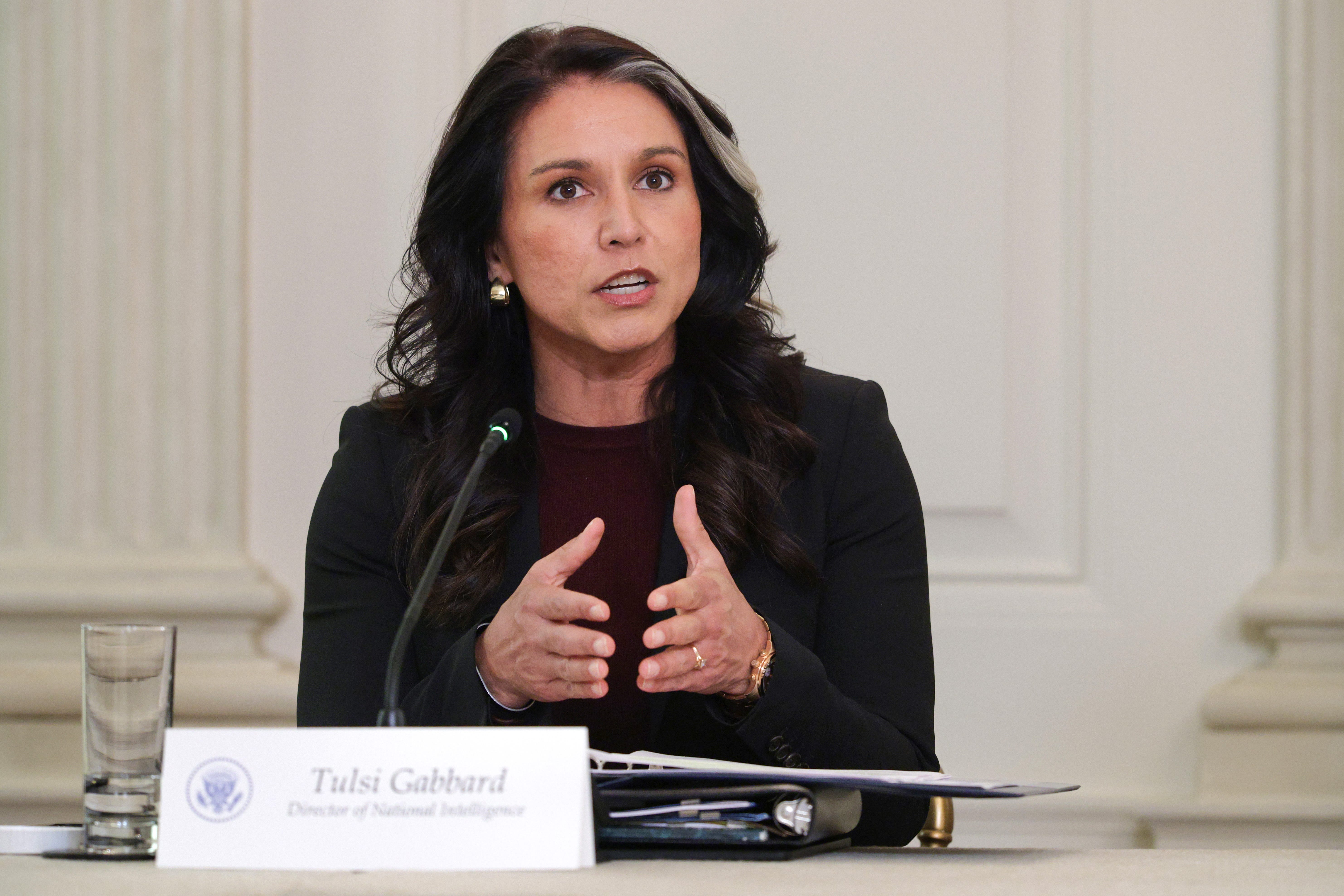
There’s only so much grist one can get from pointing out over and over again that Tulsi Gabbard has systematically flouted the deeply-held convictions she once claimed to hold. After a while, it starts to get redundant, and a bit too formulaic to even be worth harping on anymore. Yes, we’re aware that she previously made opposition to “regime change” and its offshoots the centerpiece of her presidential campaign, Congressional tenure, and entire existence as a nationally-prominent political figure. We know she used to vehemently denounce the concept of US intervention in Venezuela, Iran, and so forth, but now she’s participating in (and openly supporting) exactly those policies. Still, though: shrieking “hypocrisy” ad nauseam will eventually have diminishing returns. You can fish out all the speeches and tweets you want from several years ago, demonstrating that a particular politician had once purported to believe something diametrically opposite to what they’re doing today. But people already expect inconsistency, or even outright “hypocrisy,” from political figures. By incessantly highlighting examples of this, there’s a sense in which you’re telling people something they’ve already been conditioned to know. Which can get a bit dull. Furthermore, the notion that any politician will maintain perfect consistency across time is often derided as not just unrealistic, but undesirable, since politicians are expected to adapt to changing circumstances, absorb new information, and adjust accordingly. To exhibit “flexibility” in this regard can even be lauded as a virtue. Only a hardened zealot would insist on stubbornly clinging to their erstwhile beliefs for all eternity. Or so the argument might go. In any event, dwelling on a politician’s myriad hypocrisies, no matter how incontrovertible the evidence for them might be, can come across like beating a stale drum.
But there’s something truly novel going on with Tulsi Gabbard. Her transformation is so sensational, and so without any meaningful analog in recent political history, that it uniquely cries out for intense examination, as a phenomenon that has scarcely been observed before in the natural world. Like if one were to discover a flummoxing new fossil or celestial body.
As it happens, there was a period when I covered Tulsi Gabbard more closely than anyone else in the United States. I also got to know her decently well on a personal level. Objectively, no one is better positioned to detail her epic metamorphosis, and elucidate what makes it so distinctive in the annals of American political skullduggery.
Of course, it’s trivially common for politicians of various stripes to be “called out” for their conflicting statements, perceived willingness to compromise principles, and other run-of-the-mill “hypocrisies.” But whatever has happened with Tulsi Gabbard should almost be placed in some altogether different phenomenological category — transcending what we would ordinarily think of as mere “hypocrisy.” She’s invented a new genre of something, for which we do not even have a good name yet. Convening a consortium of philosophers, scientists, and other distinguished professionals would be necessary to fully apprehend it.
There’s also a rather pressing need at the moment for some robust inquiry. Trump appears to be barreling toward yet another military confrontation with Iran, having just reiterated his call for regime change — albeit this time under the auspices of “helping” the beleaguered Iranian protesters. The last time he called for regime change, in June 2025, it was in the context of the Israeli bombing campaign he was facilitating, soon to be followed by overt US strikes. The rapid escalation of Trump’s latest threats can almost make one forget that it was not even two weeks ago that he launched his spectacular excursion in Venezuela, raining down bombs, abducting its leader, and then declaring the US will now “run” the country in perpetuity. Then there’s whatever his latest harebrained idea is to conquer Greenland — not to mention the ongoing messes in Ukraine and Israel/Gaza. This is all of a piece with Trump becoming ever-more fixated on foreign policy, the issue area he’s increasingly devoting an outsized proportion of his time and energy to, just as Joe Biden did before him. And also like Biden, Trump seems to get a palpable thrill from this. Having proclaimed himself the sovereign governing authority in Venezuela, he now says he’s receiving hourly updates on the situation in Iran, and “HELP IS ON ITS WAY” — leaving us all to speculate what further acts of kindness and generosity might be in store. Likewise, it was only last October that Trump also appointed himself the supreme ruler of Gaza. Which is all just to say: we have entered a period where Trump really seems to enjoy exerting unfettered presidential power to dictate outcomes in foreign lands, including by deadly force, and there’s no reason to think this is going to wind down anytime soon. If anything, there’s every reason to think it will accelerate.
Which brings us back to Tulsi Gabbard. It would be one thing if she had simply discarded a position here or there, perhaps on some peripheral issue she’d never much emphasized anyway. This could reasonably subject the position to later revision or abandonment. For instance, Tulsi Gabbard once supported a federal ban on “assault weapons.” If she subsequently changed her position on gun control, especially while conforming herself to the mainstream Republican Party, this might technically qualify as an instance of “hypocrisy,” but it wouldn’t be a very remarkable one. Few would ever instinctively associate Tulsi Gabbard with the issue of gun control; it was never at the forefront of her general public presentation. She could thus jettison that obscure old position and adopt a new one — even if out of sheer political expediency — without much hassle. It would be an extremely conventional thing for any ambitious politician to do.
But it’s no exaggeration to say that Tulsi Gabbard’s critique of US foreign policy, and especially opposition to “regime change,” was absolutely central to her very essence as a public figure. It was the animating theme of her 2020 presidential campaign, and her overriding reason for running. These were the issues she proactively emphasized — in Congress, in speeches, and virtually everywhere she went. When she appeared in the media, it was most often to comment on the latest foreign policy topic that was rankling her that day. Indeed, the origin story of her entire career was that she served in Iraq, realized the folly of “regime change,” and resolved to get in the political arena so she could ensure no soldier would ever again have to fight and die in vain for some fruitless military adventure cooked up in Washington, DC by rapacious, out-of-touch elites. Even when she finally became a Republican, and endorsed Trump on August 26, 2024, she said she was doing this on the basis of her longstanding foreign policy convictions. The endorsement rollout was tied to her visiting Arlington National Cemetery, alongside Trump, and then speaking at the National Guard Association where she declared her support for him. In that speech, she stressed that Trump was the vehicle through which her long-established views could at last be enacted.
How she went about formulating this endorsement gets to why the transformation of Tulsi Gabbard is so very peculiar, at least in contemporary political history. A central plank of her argument was to retroactively endorse the first-term foreign policy record of Trump. She hailed him for having demonstrated the “courage” from 2017-2021 to make certain that he was “exhausting all measures of diplomacy” before using military force, since he understood so well that going to war must always be a “last resort.” She repeated what had then become a ubiquitous Republican talking point, which is that Trump “didn’t start any new wars” in his first term, and that’s exactly the kind of mindset we need in the next Commander-in-Chief. Misleading and obfuscatory as that line had always been, it was still standard-fare stuff for anyone campaigning with Trump — a staple of election-year Republican platitudes.
However, what made this so dramatically different from any other Trump endorsement, before or since, was not just that Tulsi Gabbard had once been critical of Trump. That would’ve almost been neither here nor there. It was that her radical about-face could not even be rationalized by reference to any form of cognizable logic. There was not even an attempt to explain how, in the very recent past, she had not only denounced Trump’s first-term policy record — which she had — she had cited it as an impetus to run for president, so she could defeat him for re-election herself! It’s not like Trump’s first-term policy record had somehow materially changed between 2020, when she was castigating it, and 2024, when she was endorsing it. By that point, the record was what it was. There wasn’t any new information to absorb, or new data to re-consider. All that had discernibly changed was the political circumstances, which had fortuitously presented Tulsi Gabbard with an opportunity to insinuate herself into the Trump/GOP operation, in hopes of securing some cabinet position. Which she ultimately did. Mission accomplished. As far as the actual policy substance, everything she’d said in 2020 would’ve been just as true in 2024 — that is, if she ever believed it to begin with. Because no effort was ever seriously made to reconcile her past positions with her newly-adopted, wildly contradictory ones. In the strange fervor of that 2024 campaign, the very recent past could be memory-holed at mega-warp speed, and hardly anyone would notice.
It should be underscored that Tulsi Gabbard’s transformation cannot be likened to other transformations characteristic of the Trump era, especially onetime Republican rivals who had viciously excoriated Trump, but later “came around” as he consolidated his grip on the party. Those reconciliations might have been partly cynical and self-serving, but they were at least explicable on some basic level of logic. For instance, Ted Cruz notoriously waged a brutal GOP primary battle against Trump, which infamously devolved into Trump attacking Cruz’s wife, intimating that his father was involved in the JFK assassination, etc. Anyone with a passing memory of the 2016 election cycle will recall the sordid details. But to the degree Cruz ever made a substantive critique of Trump, it was typically to allege that he was not a “reliable conservative,” and therefore could not be trusted to deliver on conservative policy priorities — especially appointing conservative Supreme Court justices. But then what happened? Trump got into office, and appointed Supreme Court justices who were highly amenable to Ted Cruz. Cruz thereby discarded his prior critique in light of these developments. Which at least makes sense. Trump also took all manner of other “conservative” policy actions in his first term that Cruz found favorable. So despite their onetime acrimony, the Trump-Cruz convergence was fundamentally explicable, and conformed to some baseline of underlying logic that observers could rationally comprehend.
On the other hand, by the time she belatedly got on the Trump Train in 2024, Tulsi Gabbard had already completed her comprehensive assessment of Trump’s first-term record. And what she concluded was that Trump had systematically “abused the powers of the Presidency” with a raft of “unconstitutional and reckless actions,” which she charged had “undermined the safety and security of the American people” and “demonstrated that he has acted in a manner grossly incompatible with self-governance and the rule of law.” She made these allegations not in some throwaway remark at a campaign outing, but in a formally drafted censure resolution submitted to the House of Representatives! In that resolution, she listed several examples of what she considered to be Trump’s unconscionable conduct, ranging from his support for the “genocidal” Saudi bombardment of Yemen, violations of the War Powers Act, “illegally and unconstitutionally using US military forces to occupy and pillage oilfield reserves of Syria,” and abrogating arms control treaties — among other damning offenses. That was her assessment of Trump’s first-term foreign policy record. So unconscionable, to her mind, that she was taking the extraordinary step of demanding he be censured for it.
Her less-formal remarks only upped the ante. “To all who voted for Trump bc of his antiwar rhetoric, it’s time to realize he lied to u,” she tweeted on January 3, 2020, after the drone-strike assassination of the Iranian general Soleimani, which Tulsi Gabbard condemned as an “illegal and unconstitutional act of war” that had “no justification whatsoever.” She said it proved Trump “doesn’t know what the hell he’s doing” when it comes to presidential war-making powers. She said the Trump Administration’s claim that the drone-assassination was justified because of an “imminent threat” was patently false. She even went substantially further than most of Trump’s critics at the time, declaring that a “state of war” had been instigated with Iran. “Trump talked a lot in his campaign for the presidency, and even since he’s been in office, about how he wants to end forever wars,” she said. “But his actions tell a different story.” According to Tulsi Gabbard, the attack on Soleimani showed Trump was waging a full-blown “regime change war against Iran,” and he urgently needed to be stopped. This was consistent with her prior assessment that Trump had been “leading us down this dangerous path towards a war in Iran” — a conclusion that might’ve been seen as prescient, if she hadn’t chosen to repudiate it with essentially zero explanation.
How could Tulsi Gabbard have declared in 2020 that Trump was waging a “regime change war against Iran,” which offended her most deeply-held convictions, and went right to the heart of why she was running for president to defeat him — but then by 2024, offer a stirring endorsement of Trump’s first-term foreign policy record, claiming it seamlessly synergized with the war-avoidant approach she herself had long promoted? Nothing had materially changed between 2020 and 2024! The record was what it was! The only thing that changed was Tulsi Gabbard’s characterization after the fact, which made absolutely no sense, except as a function of her having identified a chance to ascend through the Republican Party, and perhaps obtain a role in the forthcoming Republican administration, which of course requires utmost fidelity to Trump. So she does a complete 180° — absent any coherent explanation of what could have so radically changed her supposed perspective.
Say what you will about Marco Rubio and JD Vance, but at least they, like Ted Cruz, were compelled to explain their own assimilation with Trump in a manner that reflected a modicum of logical continuity. Rubio discovered that notwithstanding his own vitriolic feud with Trump in the 2016 primaries, he could steer him toward a mutually-agreeable foreign policy approach. This strategy has worked masterfully for Rubio, with him now the second incarnate of Henry Kissinger in Trump’s inner-circle. Vance makes the argument that while he once considered himself a “Never Trump guy” during the ancient days of the 2016 election, and had viewed Trump as some sort of potentially Hitler-like figure, he came to realize these were misconceptions he received from his cloistered elite bubble, and he’d been led astray by the nasty liberal media. He further recognized that Trump did a bunch of great stuff policy-wise in the first term, to re-industrialize heartland America so his downtrodden kinsfolk back home in Ohio could raise their living standards. Or something like that. It was never a very convincing argument on the merits, but at least it was something. Conversely, there was too much for Tulsi Gabbard to even begin trying to reconcile. It would’ve been totally untenable. So she’s hardly even bothered to try.
Come on: how could she possibly explain her prior claim that Trump had betrayed the nation and supported Al Qaeda? She meant this as a hyperbolic critique of Trump’s policy in Syria, which she felt was empowering Al Qaeda. As fate would have it, a former Al Qaeda commander is now ruling Syria, with the blessing of Trump, who duly welcomed him to the White House. Any chance we could get an update on this? (Crickets…)
How could she possibly explain her prior contention that the Trump Administration “wasn’t even trying to hide” that its pursuit of regime change in Venezuela was about seizing the country’s oil, when that same unhidden pursuit has only been turbo-charged in the second Administration, of which she’s a loyal member? During the first regime change gambit, Tulsi Gabbard said Trump’s policy proved he’d been captured by predatory “corporate interests” and the “military-industrial complex.” Now she says a far more audacious regime change op in Venezuela deserves major “kudos.” (It’s even been legally designated a “regime change” operation by the Trump DOJ, lest anyone still be confused.) She once lacerated Trump for “using the instruments of America’s military power for purposes that could only be described as old-style, naked imperialism,” and protested that “our soldiers signed up to protect America, not pillage other nations.” Perhaps she could explain sometime what convinced her in 2024 that Trump’s foreign policy would be less “imperially” oriented, and less geared toward the “pillage” of other nations’ natural resources, such that she felt moved to personally help him execute this policy, which by any measure is much more extreme and uninhibited than it was last time. This turn of events would have been readily foreseeable in 2024, at least if one was not busy spinning a new reality into existence to justify one’s own self-advancement.
Again, it almost feels superfluous to keep adding more examples of “hypocrisy,” because they’re just so overwhelming, it’s almost comical. But for the record: when she launched her presidential campaign on February 2, 2019, she explicitly said she was driven to enter the race because of Trump’s hell-bent pursuit of regime change across the world. “Trump campaigned against regime change wars when he ran for president,” she declared at the time, “but now bows to the wishes of the neocons around him, clamoring for the regime change wars he claimed to oppose, this time in Venezuela and Iran.”
As you might have gathered from following the news lately, Trump’s regime change initiatives in Venezuela and Iran are moving ahead with little constraint. Except this time, Tulsi Gabbard is magically in favor of them. She’ll even fudge intelligence to justify Trump’s quest to bomb Iran, as she infamously did during the June 2025 war — “phase two” of which appears like it could be coming imminently. And if the pattern holds, she’ll be on call to dutifully provide whatever assistance might be required. By any reasonable metric, that June 2025 episode was a “crossing the rubicon” moment for Tulsi Gabbard — proving beyond any lingering doubt that she’d abandoned all remnants of her prior, putative self. Because if she’ll happily volunteer to have her own “Colin Powell moment,” what wouldn’t she do? That episode happened to entail utilizing Israeli intelligence to supersede American intelligence on Iran’s nuclear capabilities. But there’s no telling what could be next on the agenda — so long as it’s in service to the whims of Trump. Whom she had once amusingly pledged she would boldly “stand up” to, and wouldn’t be “rattled by” — but that was before she decided to become his political lackey under the moniker of “Director of National Intelligence.”
Tulsi Gabbard’s current government position makes her whole odyssey even more peculiar. But also, in a sense, more explicable. The precise authorities of the Director of National Intelligence position have always been murky; there’s even been talk that people in the Administration would like to eliminate the position entirely. The position was a quixotic bureaucratic invention of the George W. Bush era. Lacking much in the way of tangible direction, she has clearly been supplanted by the CIA Director, John Ratcliffe, in terms of direct influence on Trump, or involvement in the Administration’s policy-making process.
So instead, she appears to be leveraging the DNI job as a de facto political perch, using her personal social media accounts to opine, randomly, on issues that would presumably have nothing to do with the DNI’s purview, such as the “biological distinction between male and female,” and various laws related to that distinction. Unless she’d like to clarify what ongoing intelligence matters involve the participation, or not, of Trans Women in Sports, this should be understood as her maintaining political visibility, and cultivating her prospects for future advancement, just like she did with great success in 2024. It certainly would not have been customary for previous Directors of National Intelligence to make pit-stops at the “AmericaFest” confab, as she did last month, to once again valorize Charlie Kirk. In that odd speech, she even had the temerity to throw in one of her standard lines bemoaning the nefarious influence of the “military-industrial complex” — as if her boss, Trump, was not simultaneously pushing for a $1.5 trillion military budget! AMAZING. Those remarks can apparently be chucked into the same slop-bucket as her October 31, 2025 speech praising Trump for ending Washington’s addiction to “regime change” and “nation-building.” She delivered that speech about two weeks after Trump explicitly announced an open-ended US “nation-building” adventure in Gaza, and while the Venezuelan regime change mission was being ramped up so ostentatiously that only she could have evidently missed it. Her speech also came not long after Trump and Rubio had compelled European countries to countenance the re-imposition of UN “snapback” sanctions against Iran, further obliterating the economy, which presaged the current volatile phase of that long-term regime change endeavor. (Please, no one read the resolution she introduced just before leaving Congress that effectively called for the abolition of all US sanctions, including against Iran.)
Following the Venezuela operation earlier this month, I said it was “hard to imagine anyone whose entire theory of US politics and foreign policy has been more thoroughly discredited over the past year than Tulsi Gabbard.” But I would like to amend that statement. It’s impossible to know what Tulsi Gabbard’s “theory of US politics and foreign policy” even is anymore. And that’s been true for awhile. Any through-line between her previous iterations and her present-day form has been buried to the point of un-recognizability. This really began around the time she left Congress in 2021, and started to remake herself as a bonafide Republican political operator. Becoming a paid contributor on Fox News was probably a more decisive factor in her eventual integration with Trump than anything else. By the 2022 midterms, she was bizarrely running around the country endorsing a slate of Republican congressional candidates (such as Chuck Grassley) who were approximately 0% compatible with the platform she’d so emphatically championed just two years prior. By 2023, she was hustling straight from the Fox News studio to hardcore “pro-Israel” rallies, rambling about how the true goal of Hamas was to establish a global Islamist caliphate, and how Joe Biden and Kamala Harris were supposedly coddling anti-Semites. This after she’d spent her presidential campaign denouncing the “illegal occupation” of Palestinian territory, and ridiculing the Trump/Kushner “peace plan” as “lopsided and favoring the interests” of Israel, in contrast with the “neutral” posture she claimed she favored.
Trump was surely impressed by the beatdown that Tulsi Gabbard did undoubtedly deliver to Kamala Harris during the 2020 Democratic primary debates, which exposed Kamala’s complete inability to withstand even modest pressure. This led to a gig advising Trump on debate prep in the 2024 election. She then became a featured surrogate on the campaign trail, often paired with her even-more-risible colleague Robert F. Kennedy Jr. At the vaunted Madison Square Garden rally just before the election, she declared with a straight face that “a vote for Donald Trump is a vote for a man who wants to end wars, not start them” — and that Trump would “stand up and fight for peace.” The shtick seemed to be quite effective, from a propaganda standpoint. On Election Day, I spoke to a Pennsylvania man in his early 30s who told me the main reason he was voting for Trump was that he had “brought on” Tulsi Gabbard and RFK Jr. She was clearly a useful conduit to certain segments of the electorate — call it the “anti-establishment podcast demographic.” So after Trump won the election, there she was, sauntering around with his big boy posse at the Saturday night UFC match, joined merrily by other VIPs such as the head of the Saudi Sovereign Wealth Fund. Perhaps they shared a laugh over Tulsi Gabbard’s earlier description of Trump as “Saudi Arabia’s bitch.” By the way, has Trump’s second-term agenda included any diminution of US entanglement with the Saudis? Or, per a recurring pattern, has it actually been the complete opposite?
I once did a long interview with Tulsi Gabbard, which you can still listen to in full. Toward the very end of the conversation, I pointed out that she wasn’t the first politician to insist they would be resolutely immune to “establishment” orthodoxies, and would retain their independence even amidst the perverse incentives of the power structures they were jockeying to enter. Others before her (including Trump) had promised a similar incorruptibility, only to capitulate upon taking office. What makes her different, I asked? She cited her military service as having given her an unparalleled birds-eye view of the harms wrought by “this wasteful interventionist policy that we’ve held onto in this country for too long.” She also said a bunch of other words.
I consumed your long, rambling discourse concerning Gabbard. Despite her current position as the head of all the "intelligence" services of the United States as the nation's DNI. I haven't seen any of her influences manifest themselves in the current Trump administration. As a matter of fact, in every recent cabal of foreign policy wonks and officials publically standing with Trump and his world wide power displays, she has been conspicuously absent. As you rightly observed, John Ratcliffe appears to be the official intelligence source Trump is listening to. So I share your consternation about politicos who change their positions on world political matters about as often as they change underwear. She is certainly no different than many others. However, until it can be discerned that she is more involved in the decision making of Trump and company, I personally am not concerned about her changing opinions about anything.
If you're like me (and many others) who spotted Gabbard's fraudulence from the get-go, then none of her moves are surprising. My God, just watch one of her creepy "Aloha" videos, where she's tricked out in her beautifully fitting military fatigue costumes, blathering on about her "fellow soldiers" and her sacred duties. . . . I think perhaps Michael Tracey got bowled over by Gabbard, which might explain why he seems not to be able to fathom her cynicism, her narcissistic ambitions, which require an endless lying performance.
And a performance it is. Gabbard is a con artist, an ambitious politician with utterly no principles or morals. She's always been right-wing and pro-war, and is racist to boot. One of the things that helps her to forward her rancid freight is her beauty. She's quite an attractive woman, and she's got a voice that is sultry and convincing. These physical attributes are no small reason why a lot of her admirers still think that "Tulsi" (even her critics are on first-name basis with her) will suddenly find the morals and principles she manifestly does not have and do the right thing. She will not.