

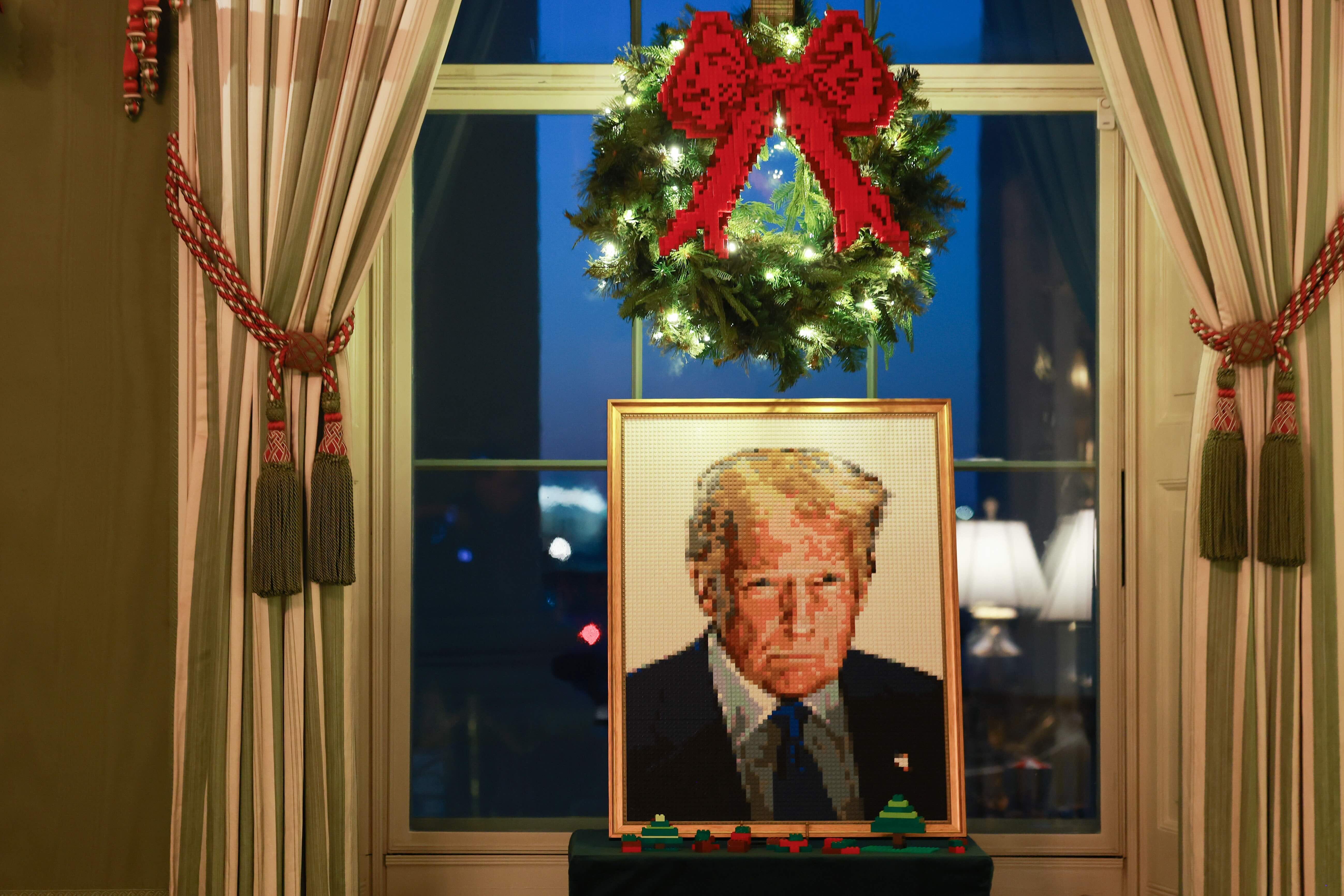
Donald J. Trump seems to be experiencing a phenomenon that has also captivated many of his predecessors, which is that they become almost monomaniacally consumed with foreign affairs, virtually to the exclusion of all else.
Not that this doesn’t make intuitive sense — it’s the domain where Presidents wield by far the most unchecked unilateral power. They can simply ignore a chronically inert Congress. They can even largely ignore public opinion, which typically doesn’t intrude on presidential decision-making until a critical mass of Americans divine some adverse impact from a far-off military action, which is rare. General lack of knowledge about international issues, coupled with a tendency to partisan-polarize around the personage of the President, makes the subject area especially ripe for shaping public attitudes in accordance with whatever the President wants to do. This can be observed in a recent poll showing that 87% of Republicans now believe Venezuela constitutes “a threat to US security.”
It’s also an area that Presidents often feel they can achieve their most enduring historical “legacies.” Gore Vidal relayed that his onetime friend “Jack” Kennedy had once explained to him that in order to be “a great President,” one must become a “war President.” That’s who the people remember and revere, JFK reputedly maintained — case in point being Abraham Lincoln and Franklin D. Roosevelt. Vidal postulated it was this meta-historical belief that broadly informed JFK’s war-making excursions in Vietnam, Cuba, and elsewhere.
George H. W. Bush exhibited a comparable mentality, taking it upon himself to rid the Nation of what he lamented was its “Vietnam syndrome” — excess skepticism of overseas adventurism — that had for too long hampered the United States from exerting rightful and overwhelming force all across the world. Bush cured this nagging malady by engineering the First Gulf War, and perhaps more relevantly for today’s purposes, the invasion of Panama. “By God,” rejoiced Bush, after Saddam was driven from Kuwait. “We’ve kicked the Vietnam syndrome once and for all!” Also for the purposes of national empowerment and rejuvenation, Bush arranged a fortuitous pretext to depose the reviled leader of Panama, Manuel Noriega, on the ground that Noriega was wanted by the United States for “drug trafficking.” Likewise, the Trump Administration has now declared Nicolas Maduro a “narco-terrorist” kingpin — and Venezuela itself a “terrorist” state. Like a Spanish-speaking Al Qaeda or something. Most recently Trump is reported to have delivered an ultimatum to Maduro, via courtesy telephone call, advising that he must abdicate his office and leave the country at once, or else be removed by force. “Mainstream” media organs such as 60 Minutes, typically thought of as hostile to Trump, have already primed the public that only three options currently exist for Maduro: he flees, gets captured by unspecified assailants, or “meets his maker” — as the correspondent for CBS News airily phrased it. Whichever of the three scenarios comes to pass, the final outcome is the same: regime change in Venezuela, effectuated by the US, one way or another.
It should be underscored that this whole escapade flows entirely from the self-directed volition of the Second Trump Administration. No sudden threats have emerged that the Administration must contend with, nor any unexpected contingencies. It’s a thoroughly voluntary ideological project, with an end-state preordained — the rest (legal rationale, political justification) to be backfilled at the time and place of their choosing. Pete Hegseth posts the snickering AI memes, but the overall effort is clearly driven by Marco Rubio, who for months has simultaneously maneuvered both as Secretary of State and National Security Advisor, with the latter putting him in closest proximity to Trump whenever he pleases. Which undoubtedly provides regular opportunities to simulate his closest historic parallel, Henry Kissinger. Day-to-day activities of the actual State Department — almost an afterthought. (Trump had previously mused that he’d eventually get around to filling the National Security Advisor job with a standalone appointment, but many months later, he seems content with the all-Rubio arrangement.)
Given that it’s such a clear-cut extension of Rubio and Trump’s personal and ideological ambitions — not something they’ve found themselves begrudgingly dragged into — whatever’s brewing for Venezuela can be placed in the annals of foreign policy “projects” that Presidents (and their top deputies) could plausibly regard as legacy-defining endeavors. After all, it was Rubio who served as Trump’s hype-man in the Senate during their first (botched) attempt to topple the Venezuelan government, so it only stands to reason that they’d give it another go, except this time with a bit more forethought and organizational muscle. In 2019, Rubio was reduced to noisily tweeting gruesome images of a bloodied Muammar Gaddafi — unsubtly warning Maduro what fate he could expect at the hands of the US. As it turned out, Maduro did not find himself battered, anally raped, and executed in the streets of Caracas. No surprise, then, that Rubio and Trump would want to “finish the job,” and fulfill their long-held fantasies — irrespective of whatever nominal opposition to “regime change” Trump’s speechwriters might occasionally have him meaninglessly voice.
Does anyone remember May 2025, when Trump went to Saudi Arabia and delivered a supposedly momentous speech that sent a bunch of Low IQ nincompoops squealing with glee, merely because Trump’s internet-brained speechwriters were crafty enough to feed him a few lines ostensibly ridiculing “neocons” and “nation-builders”? Then within a few weeks, Trump was bombing Iran in conjunction with Israel, finally delivering on a seminal “neocon” dream (if you must use that anachronistic term) of which they’d been frustratingly deprived for decades. And which may still yet lead to a full “regime change” encore in the not-so-distant future.
Trump has now even explicitly endorsed the concept of “nation-building,” proclaiming that’s exactly what he is setting out to do in Gaza — down to construction of residential compounds and training of police forces — after first having installed himself as the new supreme ruler of the demolished territory. Amazingly, he even managed to convince the UN Security Council to cosign his plan for a “temporary” Gaza governing body “headed and chaired by President Donald J. Trump.” With viceroys Tony Blair, Steve Witkoff, and Jared Kushner.
Locating profitable ventures for his son-in-law Jared is clearly another perennial passion project for Trump, even though it was widely insisted throughout the 2024 campaign — incredibly unpersuasively — that Jared would play no role in a Second Trump Administration. Fast forward to Fall 2025, and Jared arguably has a wider portfolio in this term than he did in the last one, at least when it comes to foreign affairs — again, the area where Trump has manifestly decided to direct the bulk of his energies. According to the latest news, Jared will soon be jetting off to Russia for a personal meeting with Putin, after having huddled with Ukrainian war envoys over the weekend. Despite himself holding no formal government position. Not to toot my own horn, but:
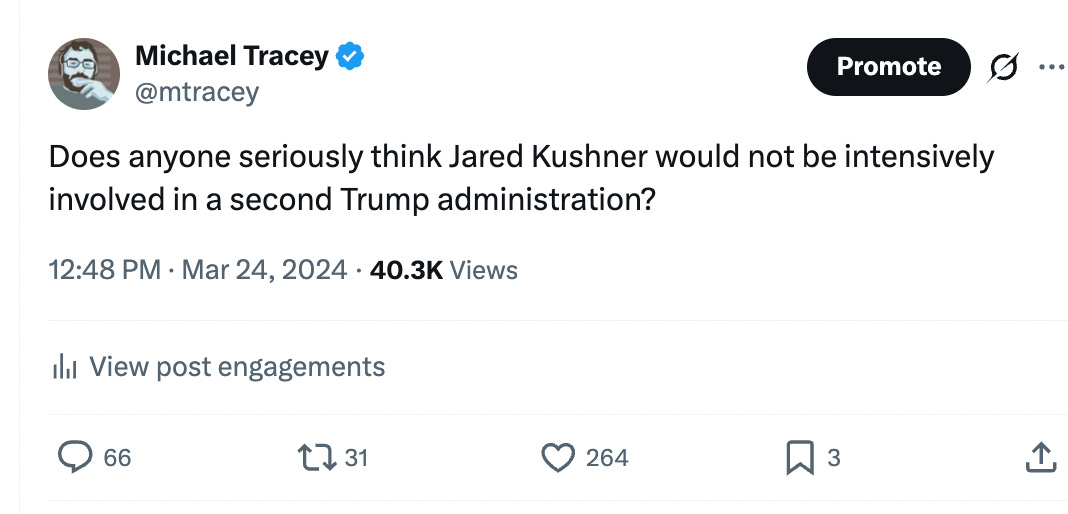
The Wall Street Journal kindly noted last year that I was (I believe?) the first to report that Kushner was playing an active role in staffing the incoming administration. I learned this simply by asking Howard Lutnick, now the Secretary of Commerce, who was happy to share the extent of Jared’s robust day-to-day involvement.
In any event, Trump’s plate is certainly full at the moment with meaty foreign policy priorities that he and his cadre can occupy themselves with for the foreseeable future: regime change in Venezuela, remaking the Middle East in the image of the Trump Organization, muddling toward some hazy resolution in Ukraine (while also escalating the US-backed warfare there, with nary a peep from erstwhile GOP critics of Ukraine war policy.)
Hence, it’s not even particularly irrational for Trump, or any President, to be so relentlessly transfixed on foreign/diplomatic/military affairs. Ahead of every presidential election, when I produce my quadrennial personal spiel laying out my rationale for voting (or not voting), I always recite some variation of what I wrote in 2024:
For as long as I’ve been legally eligible to vote, I have based my voting decisions overwhelmingly on foreign policy. The reason is simple: the US is the most powerful hegemon in world history, intervening militarily and economically all over the planet, constantly. Thus, there seems to be a special obligation for US citizens to take that into account when selecting political leadership, however much people might want to endlessly whinge about abortion and Trans Women In Sports, or whatever the latest Culture War bugaboo is in any given year.
Yes, this is unquestionably the area where the President commands the most unchallenged authority. Probably with the most far-reaching consequences of anything else in their control. So it would naturally follow for foreign affairs to be where they’d wind up choosing to spend an outsized proportion of their finite attentional resources. At least once they get their one major domestic initiative out of the way, which Trump already did months ago with his “Big Beautiful Bill.” (And even that included $8.5 billion in supplemental military funding.) So what’s left to do? Studiously devise a “health care plan”? Ha!
Look at the tariff policy: even though it’s more classically in the realm of “economic policy,” it’s given Trump yet another coercive lever to pull, whenever he likes, to shape the wider world according to his ever-changing whims. (Such as terminating all trade negotiations with Canada because the province of Ontario aired a television commercial he didn’t like.) Joe Biden, whatever his diminished faculties, also sought to use the presidential powers at his disposal to conform the world to his ideological and personal proclivities, which tended to be more centered on multilateral institutions as a locus of US primacy and prestige; he was famously befuddled that more Americans weren’t appreciative of how steadfastly he’d presided over joint NATO activities in Eastern Europe.
And so Trump has now conjured this latest Venezuela thing, essentially out of thin air. He started bombing random boats in September, claiming his objective was to vanquish “sex trafficking” (LOL) in the Caribbean Sea. Anyone who’s bothered to moderately familiarize themselves with the topic recognizes that Venezuela is not a significant source of US-bound “drug trafficking,” particularly fentanyl. That’s why you’re better off just ignoring the specious and contradictory rationales put forth for this operation, and simply view it as of a piece with the “legacy” aspirations Trump has imagined for himself, prominently including the raw expansion of American hegemony — albeit with a Trump-specific twist.
While it was strangely under-remarked on at the time, recall that Trump came barreling into office this year with an inaugural address heralding William McKinley, of all people, as the historical model for what his second term had in store. McKinley was the first President to send US forces on overseas expeditionary crusades, and in so doing annexed various far-flung territories (such as Guam and the Philippines) that were previously unknown to 99% of Americans.
It wasn’t long after Trump’s curious 2025 address that he started revealing his apparently long-concealed desire to likewise annex a whole host of far-flung territories, such as Greenland, Panama, Canada (a “joke” that eventually stopped being funny), and Gaza (another “joke” which came to fruition in a matter of months.) Oddly, none of this ever came up during the tediously protracted 2024 presidential campaign, in which Trump was a declared candidate for literally two full years.
His policy toward Ukraine can be viewed in the same light, with Trump demanding a so-called “minerals deal” that effectively turns Ukraine into a sort of quasi-colonial US outpost, with the US expropriating vast swathes of Ukraine’s natural resources and physical infrastructure, in return for an uninterrupted supply of US weaponry. (The provision of which Trump has cleverly found a way to bypass any Congressional oversight or appropriations for.) Who knows what Kushner, Witkoff, and Rubio will ultimately cook up in terms of a “peace proposal” for Ukraine — if anything — but the early drafts of their negotiating document envision the US “leading” and thereby profiting from prospective “reconstruction” enterprises, including by seizing $100 billion in frozen Russian assets, paired with an indeterminate US “security guarantee” to defend Ukraine’s “sovereignty.” No doubt this intensified military, economic, and political entanglement with Ukraine (which I seem to recall online MAGAs once vehemently denouncing) will be sold as a “great deal” for the US.
So too will the fruits (or ravages) of regime change in Venezuela be sold — whatever the vapid sloganeering of MAGAs (and Democrats, for that matter) who claim to vaguely oppose “regime change” as a floating abstract principle. Magically, this alleged conviction always seems to be held in suspension when real-life “regime change” scenarios actually come to the fore. As I wrote way back in 2017:
“Regime change” is incredibly easy to oppose in the abstract. Seldom will you hear anyone of note tout their support for “regime change” as a general principle, and even the most unrepentant US hawks now typically acknowledge that previous “regime change” efforts undertaken in Iraq, Libya, and to some extent Syria have had disastrous results. The term itself — “regime change” — usually only comes up as a pejorative, and as an object of criticism.
That’s why it’s imperative to discern accurately a politician’s views on “regime change” by reference to their position on particular, specific conflicts or initiatives, rather than their general feelings about “regime change.”
“Regime change” as a desirable policy option is so ingrained in the body politic and the political class — perceived as so normal and so rational — that the people who demand it often aren’t even fully conscious of what it is they’re advocating. They can develop these elaborate mental gymnastic constructions that on the one hand allow them to pose as skeptics of “regime change” in the abstract, while on the other hand favoring specific instances of “regime change” policy without explicitly framing it as such.
The mental gymnastics sure to accompany the Venezuelan gambit (and they’re already in full swing) are just as predictable as the gambit itself. Trump enjoys an unrivaled capacity to bend reality to his will, particularly among his hardest-core supporters — but even to a large degree among his enemies, who are barely even conscious anymore of how instinctively they orient their own realities in perverse relation to him. (Maybe I’m also guilty?) Foreign policy is where this reality-bending power can be most decisively employed. Hopes are surely waiting to be realized that ousting Maduro could even produce a “Domino Effect” and foment the ouster of other meddlesome figures in the region. “We’ll see what happens,” Trump is always fond of teasing. Yes, we will — whether we like it or not.
Why is he fixated on Venezuela?
I will give you a hint, it rhymes with 'boil'.
It's also a criminal war of aggression to attack Venezuela to overthrow its sovereign government. Maybe Michael's too jaded to note that fundamental point, or that such a move, however it's carried out, will likely blow up on the Trump regime if he tries it.This is not Panama. American soldiers will come home horizontally and chaos will ensue. Are Trump and Pistol Petey that stupid? Probably.