

Here’s an article I had published today at UnHerd on the latest upsurge of consternation around Graham Platner, who I suppose is on the verge of becoming, or has already become, something like a new household name for anyone minimally attuned to US political affairs. I admit I hadn’t followed the Maine senate race very closely until about a week ago. Of course, I’d occasionally see some flicker of controversy involving Platner, whom I knew had unconventionally ascended to presumptive Democratic nominee despite being a pure political novice. And of course, I am well aware of Susan Collins. One of the funniest outcomes of the 2020 election was that she sailed comfortably to victory over a much-hyped Democratic challenger, despite virtually every poll in the lead-up projecting Collins’ defeat. I guess I shouldn’t overstate my ignorance too much; I’m sure I’d read an article here or there on Platner’s improbable rise in the past couple months. But I hadn’t really done a proper “deep dive” on the main controversies animating the race.
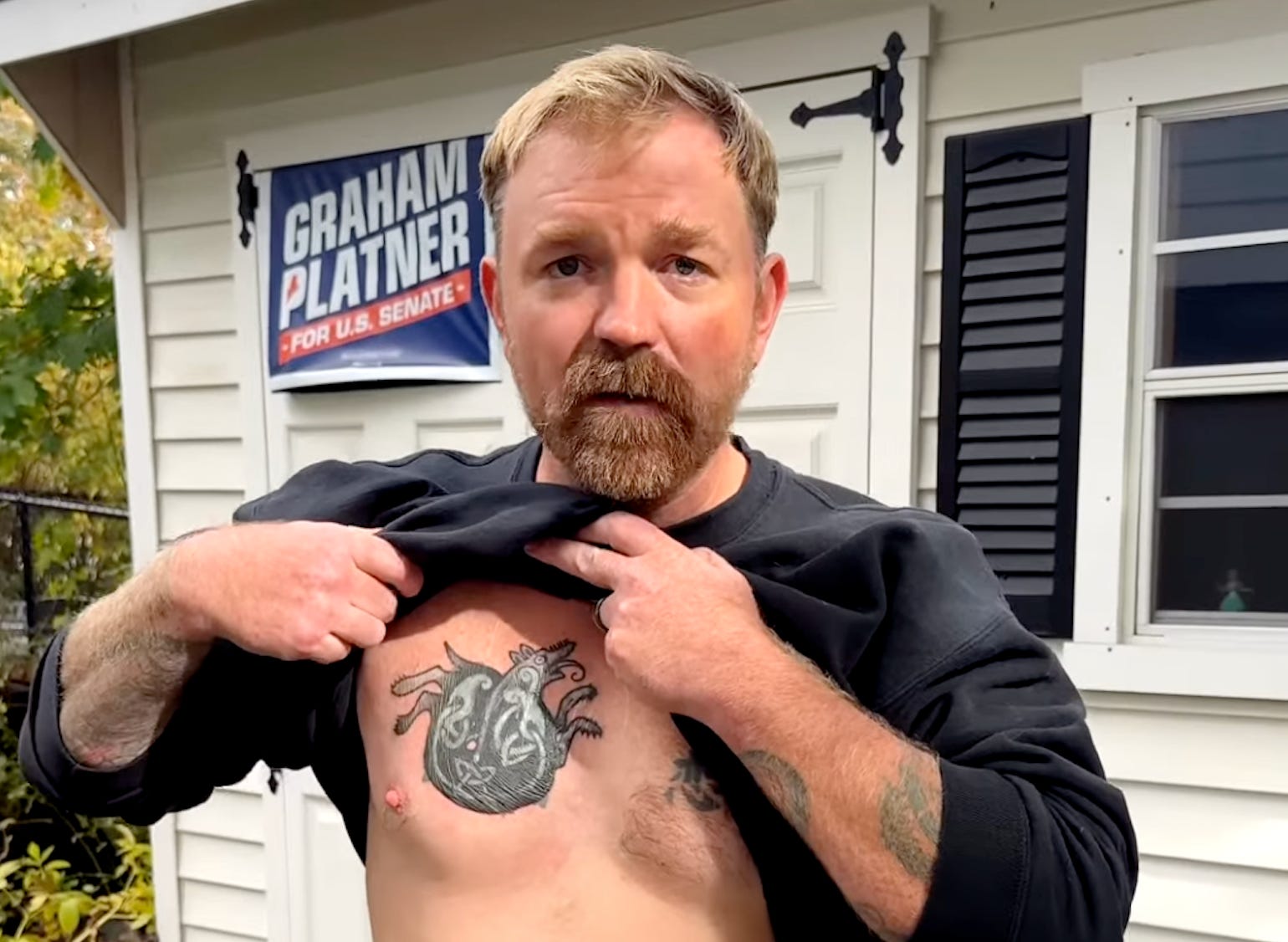
The principal controversy I’d sporadically heard about was that Graham Platner apparently had some sort of “Nazi tattoo,” and claimed he’d only been recently informed that the tattoo was connected to Nazism. Whereupon, he got another tattoo to cover up the offending image. It occurred to me last night that I couldn’t recall ever seeing the actual tattoo. So I pulled it up, and saw this:

“Wait, really?” I thought. I had always kind of vaguely assumed the tattoo in question must be so obviously evocative of Nazis or Hitler that the average American would take one look at it and immediately know the connotation. Foolish naivety on my part. I’ll acknowledge, perhaps embarrassingly, that the symbol did not even immediately leap out to me as obviously associated with Nazism. While I’m far from the biggest World War II nut to ever exist, I do know a fair amount, including about Nazi Germany. But for whatever reason, I genuinely would not have recognized the symbol at first blush as Nazi-related. To me, it kind of just looks like a generic “skull and crossbones” symbol that one could imagine rabble-rousing guys in the military thinking looks cool. Someone should commission a poll to ascertain what percentage of Americans would proactively identify this as a “Nazi” symbol, because I’d guess the percentage would be quite low.
Anyway, Platner continues to be excoriated for his now-infamous “Nazi tattoo,” since he shamefully failed to consult the Anti-Defamation League “hate symbol” database before getting himself tatted up years ago. My take is that whatever the exact details of Platner’s tattoo folly, everyone should just relax in general about Nazi-related symbols, because they’re really not that big of a deal anymore.
One might retort: Hey, what about that big controversy over the past several years about a certain military unit in Ukraine, the Azov Battalion/Brigade/Regiment? Didn’t you used to complain that soldiers in this unit were routinely being spotted with Nazi insignia emblazoned on their uniforms, vehicles, and so forth? OK, fair question. It’s true that I would sometimes point out the prevalence of Nazi-type imagery among Azov fighters and followers, and I’d comment on various political tensions brought to bear by this conundrum: namely, that Democrats and left-liberals were deafeningly silent about the heavy arms being funneled to the seemingly Nazi-friendly unit, even though they’d otherwise be on hair-trigger alert to declare a blithering moral crisis anytime some schlub loosely affiliated with Trump or “MAGA” could be claimed to have exhibited a tenuous, theoretical affinity with purported Nazis.
The most subtle possible indicia of such Nazi-related offenses were vigorously monitored by Dems and likeminded busybodies, especially outfits like the Southern Poverty Law Center and Anti-Defamation League, neither of which would provide me with a comment when I asked them to weigh in on Azov supporters holding political rallies in the United States — see this 2022 article. No comment, they said, despite the ideological lineage of Azov being far more straightforwardly redolent of bonafide Nazism than most of the ticky-tack stuff we’d been instructed to freak out about multiple times a week in the Trump era. Infamously, the “OK” hand gesture was deemed at one point to be a nightmarish display of Literal Nazism. When contrasted with the decidedly muted response to the sudden adulation of Azov, which was not just receiving political and media plaudits, but armaments from US military contractors, the farcical insincerity of earlier Nazi-related freakouts was made too painfully obvious to not sardonically ridicule.
However, the article I wrote on the matter was principally a meta-critique of domestic American political hackery — that the moment a glimmer of purported Nazism was sighted anywhere, it would ordinarily be cause for the most spectacular sputtering meltdown, and yet when this far more tangible manifestation of purported Nazism appeared in the wild — Azov and its boosters — it could be simply ignored by the very same people who just got done telling us that ascendant Literal Nazism was a defining feature of American life. That was the thrust of what I was trying to convey in my article, as opposed to carefully analyzing the precise ideological contours of Azov, or drawing any firm conclusions about the extent to which Azov adherents circa 2022 could be substantively tied to Nazism.
In fact, I was skeptical that each and every fighter in that unit could be reasonably described as full-blown Nazi. That just didn’t seem plausible, notwithstanding the origins and/or founders of the group, who at one time were very explicit and unapologetic about their Nazi-adjacent ideological commitments. And even if the ideological forebears of Azov could be downgraded to mere “right-wing nationalist,” that still would’ve been more than sufficient for American liberals to have a frothing panic attack, except for the overriding political imperative at the time to Stand Unflinchingly With Ukraine.
That said, even though it became a popular talking point on Russia-supporting social media, and among Russian state actors, to uniformly condemn anyone and everyone associated with Azov as outright unambiguous Nazis, my intuition was always that this was probably not accurate. Groups that start out on the fringes, like Azov in 2014, inevitably “moderate” to some degree as they become more institutionalized and “mainstream.” Ukraine was seen as the vanguard for some grandiose defense of “liberal democracy,” and as such, one could imagine that new recruits with non-Nazi predilections were being increasingly drawn to Azov as of 2022. Furthermore, even well before the war, one of Ukraine’s state objectives was to join the EU, which would entail shorning itself of distasteful ideological elements, such as Nazism, thereby proving to EU chieftains that Ukraine had firmly embraced “liberal democratic values” or whatever.
So while it stood to reason that there were likely some factions of Azov who did espouse something akin to Nazism, it also stood to reason that other factions, and perhaps even the most rapidly growing ones, were not at all sympathetic to Nazism, and in fact would genuinely deplore being conflated with Nazis. Does this make the American pundits and elected officials any less clownish for having zero compunction about gifting Azov commanders with high-powered weaponry? Not really, because again, even the faintest whiff of Nazism would usually be enough for them to howl with the fury of a thousand Resistance Warriors. But as to the nature of Azov’s true ideological composition circa 2022, to me the reality was likely more ambiguous. Here’s what I wrote at the time:
Now, one might reasonably ask: isn’t this whole “Nazi” angle a bit overblown? After all, in the U.S., that label gets blithely slapped onto anyone who’s slightly more right-wing than Mitt Romney. And it’s not an unfair point. The elasticity of the term “Nazi” has become so preposterous, and it was deployed so indiscriminately during the era of Trump, that one could be forgiven for having an urge to immediately eye-roll whenever they hear it uttered.
Here’s the point, though: in a prior political context, the purported existence of Nazis was supposed to prompt an earnest outpouring of shock, horror, and counter-Nazi mobilization. But in the current political context, the existence of Nazis is supposed to be carefully ignored — in service of what is now the superseding imperative, namely to “Stand with Ukraine.”
Because even if not every Azov fighter actively subscribes to full-fledged Nazi ideology — which is plausible — they would still resoundingly meet the media’s typical criteria for instant explosions of hair-on-fire condemnation. There are currently mountains of evidence, much of which was contemporaneously gathered over the course of the ongoing war, that Azov “defenders” at the very least physically adorn themselves with unabashed Nazi symbols. Examples of such symbols that have been recently observed on their uniforms include the Wolfsangel, the Black Sun, and even a crest of a division of the SS — the paramilitary organization of the actual, historical Nazis. You know, the ones commanded by Hitler who exterminated lots of Jews. If a bunch of Trump supporters were running around with these symbols stitched onto their clothing, do you suppose the U.S. media would be extra charitable in deciphering whether they really subscribed to Nazism?
Notwithstanding the meta-political points I was trying to make about Azov in 2022, I would’ve continued to maintain — then and now — that the knee-jerk moral mania around anything vaguely to do with Nazis is beyond tedious, and should no longer be legitimized. Sure, if someone really does venerate Hitler, or really wants to impose the governing program of the Nazi Party, that’s something I would personally object to on the merits. You could reasonably hold such views against a person politically. But the instant hysteria generated by any fleeting mention of “Nazi” is so trite and performative at this point, it’s tiresome. Nazi Germany hasn’t existed for over 80 years. Hitler has been dead for slightly longer. There is no Nazi-related emergency upon us in 2026, notwithstanding the occasional presence of political actors whose ideological lineage could arguably be traced back in some roundabout fashion to historic National Socialism.
But even if that genealogy is plausibly well-established in some cases… so what? You don’t have to agree with it! In fact, you are more than entitled to enthusiastically oppose it if you feel moved. But there is no longer need for the reflexive moral outbursts. Any putative concern about Nazi-related views in 2026 can be easily addressed through ordinary modes of political disputation, without a mandatory eruption of overwrought screeching — the same way that potentially objectionable views associated with liberalism, socialism, communism, conservatism, anarchism, or other ideological tendencies can be rationally addressed.
In light of this, I would argue that even if Graham Platner did vaguely know that the tattoo he got in 2007, while on leave from the military in Croatia, was in some roundabout sense associated with “Nazism,” it’s just not that big of a deal. It’s certainly not worth proclaiming as the central fact of his political identity or governing plans. Especially if there’s no good reason to suppose that he subscribes to a worldview that has anything to do with Literal Nazism. Because in Platner’s case, he almost certainly and conclusively does not. He seems to be a generically left-wing-ish guy who likes Bernie Sanders, but has also inhabited more masculine or even right-wing-coded cultural milieus — such as serving in the military — than is perhaps typical for the average “progressive Democrat.” (Which is probably part of his appeal to a certain segment of voters.)
So in other words, there is no sensible reason to believe, as far as everything I’ve seen, that Platner acquired the purportedly offensive tattoo in order to signify his own personal affinity with Nazism. Even if he knew all along, or eventually came to know, that the tattoo was aesthetically stylized in a manner reminiscent of Nazi symbology — so what? What is that supposed to demonstrate? Do you really think he’d get into office as a Democratic senator from Maine and start agitating for the extermination of Jews or something? Please. This is all just hackneyed political blather — a “liability” for Republicans, and probably some Democrats, to eagerly slam him for. But it just doesn’t matter that much on the merits.
I’d go so far as to say that even if he did hypothetically get the tattoo to signify some affinity with historic Nazism, that too would not matter all that much. Because I’m sorry — Nazi symbols do not contain any dark magical substrates, whereby anyone who’s ever displayed them is cursed for all eternity and forever frighteningly evil. I just don’t believe that, as much as I would substantively object to the imposition of a political program modeled on National Socialism. But it would still be moot in Platner’s case, because I think the most you could credibly argue is he might’ve been notionally aware that the “skull and crossbones” on his chest was aesthetically evocative of Nazi iconography, or perhaps had been appropriated by the Nazis — even as he himself never conceived of the tattoo as signifying his own personal support for Nazism.
If you gave him truth serum, I’d bet he would probably give a convoluted rationale along these lines for why he got the tattoo in the first place, and then kept it unperturbed for 18 years. I gather that lots of people end up getting tattoos to which they assign their own semi-private meaning. But explaining this “semi-private meaning” to the public is probably not something he’d be easily able to do in the context of a high-profile Senate race, so he cut his losses and got the thing blotched out last fall. Maybe he would’ve been better off just keeping it though, because the “cover-up” doesn’t seem to have dulled the controversy at all, and kind of just hobbles his ability to explain it convincingly.
I honestly can’t bring myself to care that much one way or another about whether Platner beats Susan Collins, or by extension, whether the US Senate is controlled next year by John Thune or Chuck Schumer. That’s just not something I envision myself getting overly exercised about, or psychically invested in. To the degree I am currently interested in the Maine senate race, it’s to document the deluge of propagandistic sleaze being pelted at Platner, with a nice assist yesterday from the New York Times, whose star correspondents Katie Glueck and Lisa Lerer decided it was of paramount journalistic importance to survey Platner’s ex-girlfriends, going back to his 20s, and have them pontificate on his character traits.
The journalists additionally thought it was of utmost importance to have several of these chagrined “exes” emotionally reconstruct and narrativize their past experiences with Platner, to create a psychological profile from which the NYT could purport to divine a pattern of his “unsettling” behavior. Of supreme newsworthiness, evidently, is that a handful of these women recalled their past relationships with Platner could sometimes be “volatile” and “emotionally wrenching.” If this is super-newsworthy stuff, then as I proposed in the UnHerd piece, it’s only right that Katie Glueck and Lisa Lerer also have their ex-boyfriends canvassed, and invited to share their recollections of any “volatile” or “emotionally wrenching” relationship dynamics they might call to mind from back in the day. This would undoubtedly give us all much-needed insight into the subtle influences permeating the political coverage of the New York Times — at least if they’re saying such information gives us crucial insight into the office-holding ambitions of Graham Platner.
Also of interest for my admittedly niche, peculiar purposes is that the Maine Senate race is poised to become yet another national bellwether of the Great Pedo Panic, with Platner having been predictably declared a pedo already, on predictably scurrilous grounds — because there are seldom any non-scurrilous grounds on which pedo accusations are flung as of late. His crime: having an account on the app “Kik,” which featured a profile picture of him shirtless and wearing a towel around his waist. The app is claimed to be disproportionately populated by vulnerable, underaged minors getting sexually preyed upon by adults, so the mere fact of Platner having an account is seen as adequate to call him a pedo. Despite zero evidence that he ever did anything sexually predatory with anyone of any age, much less children.
Republican polling firms have excitedly reported that when they test out the resulting attack line with Maine voters — that Platner has been caught patronizing an app known as a “paradise” for “child predators” — his favorability ratings unsurprisingly plummet. So we can expect to see this Pedo Panic trolling amplified at full blast for the next several months, as millions and millions of dollars pour into Maine, where the balance of power in the Senate could be decided. Lots of deep-pocketed donors are so very passionate about whether the chamber is controlled by John Thune or Chuck Schumer.
This agglomeration of slime hurled at Platner is outlandishly scummy, in my view, and so the race does merit some critical attention, notwithstanding my sincere lack of strong feeling one way or another about the desirability of his candidacy, compounded by my general apathy about which party obtains a majority in Congress. Not that I won’t be covering the midterms in some form — I inevitably will. I’m just saying that from the standpoint of my own personal preference, I simply do not care all that much about the ultimate electoral outcome. Even so, there will be plenty of insights to glean about the latest pathologies of US political culture, and so in that spirit, I guess I will be intermittently following the Platner/Collins race. Maine’s nice in the summer anyway!
You're slowly but relentlessly becoming one of my [teeny handful of] favorite Substackers.
Re the attacks on Platner--who does seem though like a guy who develops a really skeezy smell when he sweats too much--Lynsey Fifield seems like a gal entirely deficient in survival instincts or alternatively is a terrible fiction writer.
Anyway it's hard to get too outraged by the Democrats cleaving to Platner in an almost Biblical sort of betrothal. If I were in Texas I'd vote for Paxton to do my part in thwarting potential Democratic take-back of the Senate and that would bring my whoring out of my integrity for the sake of the nation to new heights [depths?] of self-besmirchment and I ain't even a Republican.
Ok. So the Nazi tattoo doesn’t bother you. It’s not a deal killer for me either. But that fact that he’s mentally unstable does. War vet or not.