

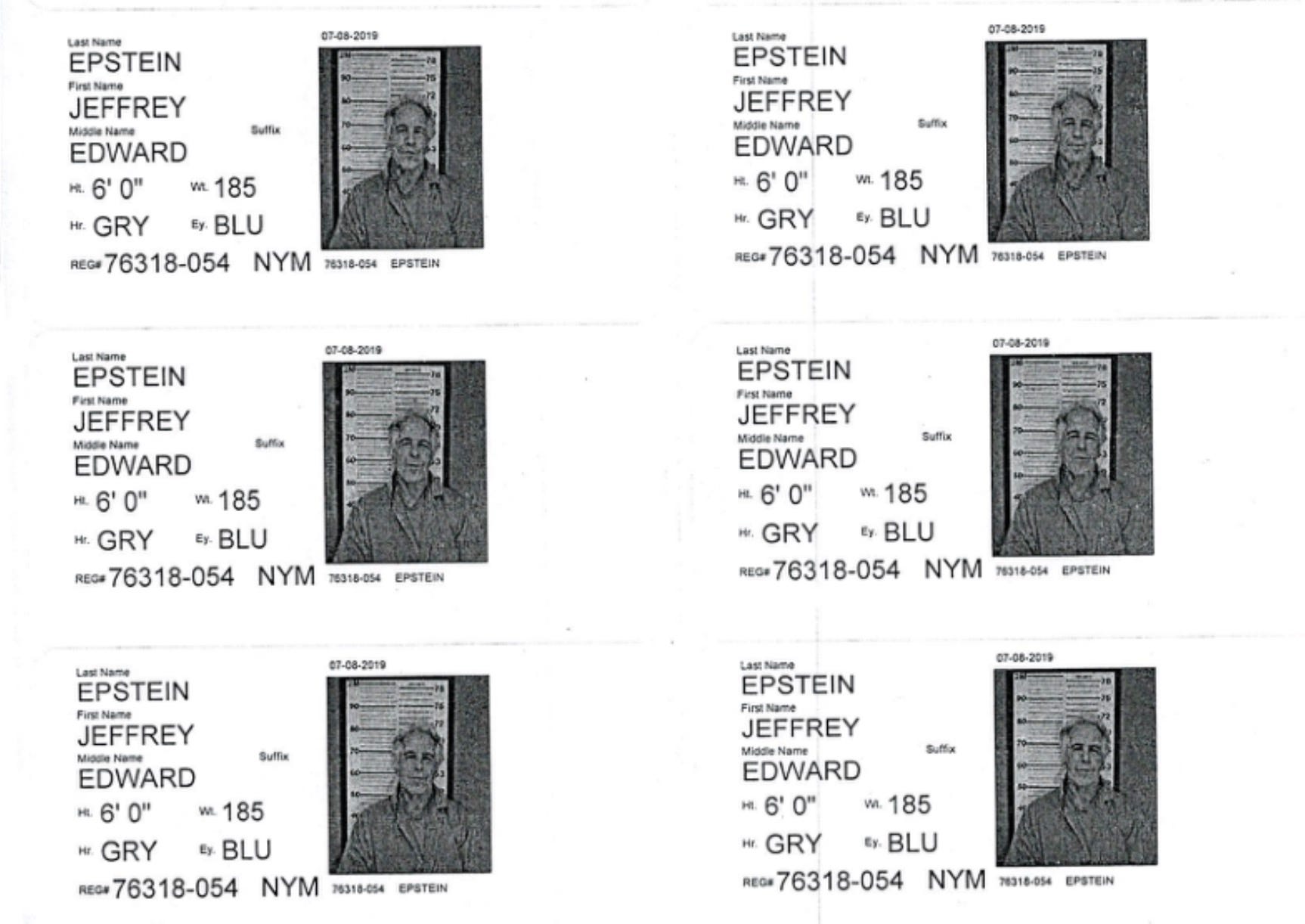
Seven years ago (yesterday) — July 2, 2019 — Jeffrey Epstein was indicted by a federal Grand Jury for perpetrating a “sex trafficking conspiracy,” based on conduct alleged to have taken place between 2002 and 2005, and which the Feds had largely already investigated over a decade before, culminating in a 2007 determination that any indictment brought against Epstein would’ve faced such severe evidentiary and legal “challenges” that prosecutors actually feared he could be acquitted at trial, which is extremely rare in the federal court system.
Today it’s received wisdom that the 2019 case against Epstein must’ve been airtight, bulletproof, no-doubt-about-it: such an obvious slam-dunk, that to even give it a second thought would be absurd. Of course he was heading straight for the slammer — it was only a matter of the Feds going through with the formalities.
Well…….. don’t be quite so sure. Like most received wisdom, this conceit is something that gets blithely assumed, studiously unexamined, and automatically believed by the same kinds of people who think they know everything there is to know about Epstein because they listened to some dopey podcast, swallowed some social media slop, and maybe half-watched a Netflix propagandocumentary.
If you read my previous article, you will be familiar with the exciting legislative history behind the Trafficking Victims Protection Act of 2000, and how radically it’s been transformed into a catch-all statutory fly-trap that now essentially enables prosecutors to charge whomever they want, whenever they want, for whatever they want, thanks to the infinite conceptual elasticity of “trafficking,” and the infinite bend-ability of the elements underpinning it.
Epstein was charged in July 2019 with a “sex trafficking conspiracy” per the TVPA. As far as the government alleged at the time, it was a conspiracy of one. Re-reading the indictment again, one gets the sense this was intended as a major “work in progress” — which is to say, Maurene Comey and her colleagues in the Southern District of New York had a lot of work on their hands, and a lot of heavy “trafficking” theory to weave out in the months ahead. Such creativity didn’t turn out so well for Maurene & Co. in 2025, when she was brought along to help convict Sean “Diddy” Combs on a similarly convoluted “trafficking” theory; at that point, even Manhattan jurors weren’t buying it, and they voted to acquit Diddy of the government’s headline “trafficking” charge. Despite this sizable mishap, it’s doubtful that the Feds have dampened their enthusiasm for pioneering “novel” applications of their favorite “trafficking” statute. An interesting discovery in the “Epstein Files” is how profusely the DOJ and FBI were congratulating one another for going so hard after Jeffrey Epstein and Ghislaine Maxwell — so boldly and imaginatively — including by stretching the bounds of “trafficking” law to such soaring new heights. Literally, they were giving each other awards for this:
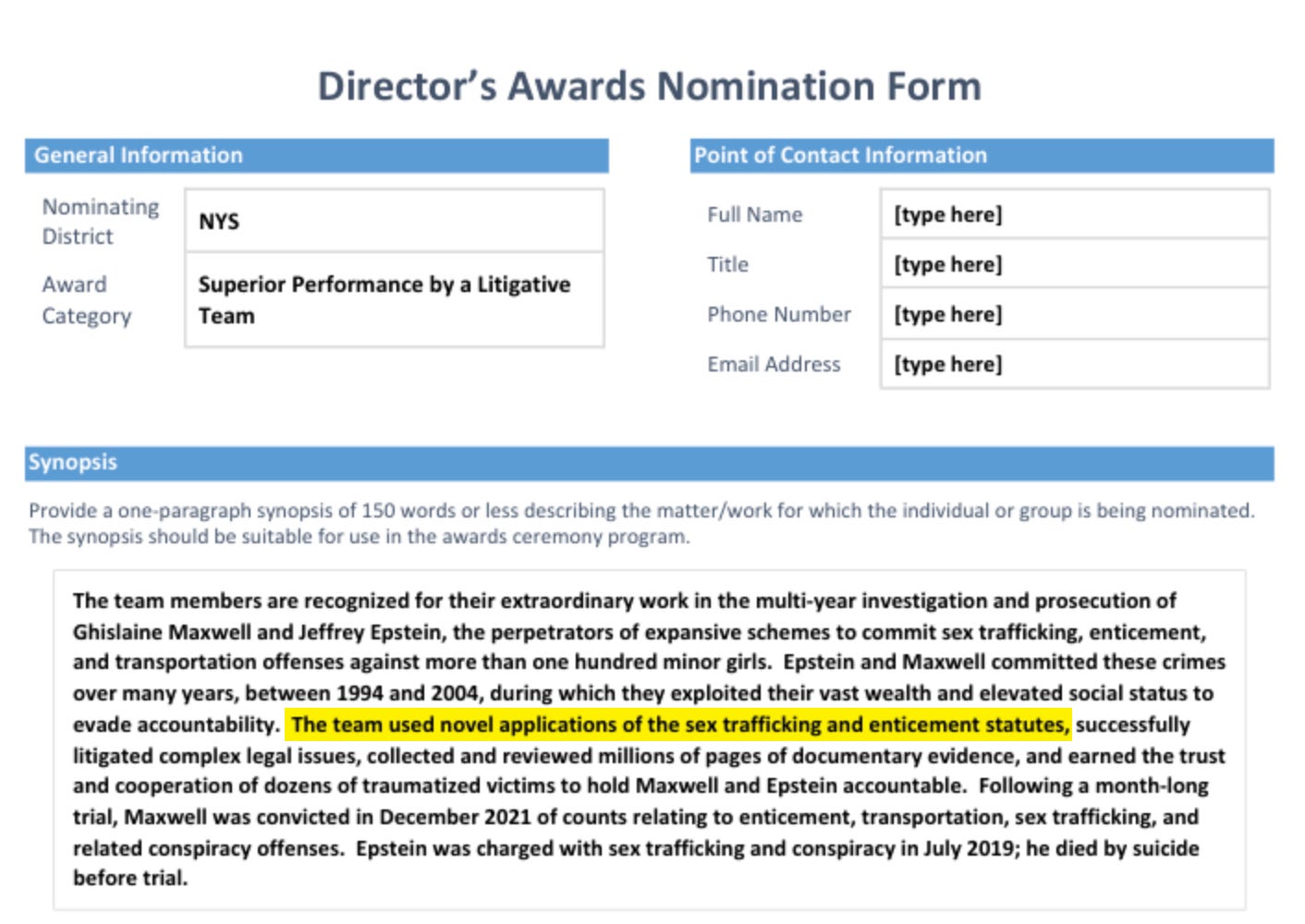
They even held a big “awards ceremony” on May 3, 2023 to kiss each other’s asses for this superlatively “superior performance” — coming up with all these impressively “novel” methods to get Epstein indicted and hauled off to jail, where he soon wound up dead. Oddly, the DOJ party-throwers and award-givers do not seem especially chastened by that outcome. Maybe because they were able to lock up Maxwell in his stead, and this was all the reason they needed to celebrate. What’s curious is that it should’ve taken such “novel” prosecutorial and investigative efforts to accomplish their task, since we’ve been so loudly told that Epstein and Maxwell were running the most prolific “child sex trafficking” operation in recorded human history. You’d think the means by which to punish such blatantly heinous acts would have been rather straightforward, and not require any elaborately conjured “novelties.”
Nor is it necessarily the most heartwarming thing for prosecutors and FBI agents to be jumping around giving high-fives for the brilliant new strategies they’ve innovated to toss people in prison for multiple decades, based on their private abstruse statutory re-constructions, indecipherable as they may be to ordinary citizens of average intellect — but hey, what do I know.
Be all that as it may, you might be asking: surely there’s no question they would have secured a conviction of Jeffrey Epstein? Surely I can’t be suggesting that even the most dimwitted set of prosecutors would have failed to convince a jury that Satan Pedo Hitler himself was guilty of “sex trafficking” crimes?
Well.…… again……. not so fast. First off, there are a million ridiculous misconceptions about what actually went on the first time the Feds considered prosecuting Epstein. And there’s a reason why they didn’t go through with it! No, not because he was “intelligence,” or because they were corruptly bought off by some cabal of nefarious pedo conspirators, but because the merits of the case they would have to prove were just nowhere near as solid as you’ve been lazily led to believe. That they compelled Epstein to accept the now-infamous “Non-Prosecution Agreement” was probably about the best the Feds could have hoped for in 2008, given the mountain of evidentiary and legal complications they encountered — the basis for which would only grow in the years that followed.
For instance, the lead detective in the initial Palm Beach police investigation, Joseph Recarey, who later got glorified as a truth-telling-justice-seeking folk hero by the Netflix-brained narrations of the tale, sat for a series of depositions in 2010, pursuant to one of the many Jane Doe civil cases brought against Epstein. On April 27, 2010 he was questioned by Martin Weinberg, one of Epstein’s defense attorneys; Epstein himself was also apparently in the room that day. To my knowledge, the full deposition wasn’t available in the public domain until January 30, 2026, upon the mass-dump of “Epstein Files.” (Or at least wasn’t findable enough that I was ever able to find it when I’d previously looked.) Recarey’s testimony could have raised a bunch of decidedly awkward issues for any hypothetical prosecution of Epstein, whether retrospectively in 2008, or prospectively in 2019. A choice excerpt:
WEINBERG: So Ms. [Jane Doe] did not engage in prostitution, but others did, during the course of the investigation?
RECAREY: I wouldn’t say others did. It’s a negotiation. If you’re paying for a sex act, it’s a negotiation. You get X for Y.
WEINBERG: So that if the negotiation was purely for a topless massage, then there was no prostitution?
RECAREY: Not in my eyes, no.
WEINBERG: So in your eyes, were any of the so-called victim/witnesses, did any of them engage in prostitution?
RECAREY: Do you mean since that time, or—
WEINBERG: Well, let’s start with that time, when Mr. Epstein was the customer. Were any of the women going to his house engaging in prostitution, in your opinion?
RECAREY: In my opinion?
WEINBERG: Yes.
RECAREY: No.
WEINBERG: And that included those who were going to his house who were above 18 as well as below 18, correct?
RECAREY: Like I was told, people that I interviewed that were above 18, what happened between them were between two consenting adults.
[…]
WEINBERG: And therefore, in your opinion, the women going to see Mr. Epstein were not going there pursuant to a prostitution agreement, correct?
RECAREY: Correct.
WEINBERG: They were going there as consenting adults or even consenting minors to do something other than prostitution?
RECAREY: They were going there to provide the massage but, you’re right, it wasn’t prostitution.
WEINBERG: And in fact, had some of these girls that went there who were under 18, had they been over 18, then this entire case would have been a consenting massage case, correct?
RECAREY: If they were over 18?
WEINBERG: Yes.
RECAREY: That it would have just been what, a massage case, you said?
WEINBERG: It would have been a case between two consenting adults, other than prostitution.
RECAREY: Unless we got a complaint.
Several things stand out here. First, bear in mind that Recarey was highly zealous in pursuing maximum criminal sanctions against Epstein. That’s why he complained to the Feds, in July 2006, when he felt the Palm Beach County State Attorney was settling for an insufficiently punishing solution to the Epstein question. Somewhat bizarrely, Recarey said his Epstein-related communications with federal officials came about by way of his assignment to a “Joint Terrorism Task Force,” through which he was already in daily contact with the FBI. In any event, whatever statements Recarey might have made that tended to lessen Epstein’s culpability would have to represent an “admission against interest,” and therefore carry particular weight. Recarey’s testimony in the 2010 deposition could thus plausibly pose a number of problems for the Feds to establish the “sex trafficking conspiracy” they eventually charged Epstein with masterminding. Recarey did not even regard the acts Epstein committed with the various Palm Beach girls, whether they were above or below the age of 18, as “prostitution” — meaning, in modern “trafficking” lingo, Recarey did not believe there was a “thing of value” exchanged for any sex act, so the acts in question would not have been, to his mind, “commercial sex acts” — a required element to prove “sex trafficking” under the TVPA.
(For the record, I would actually tend to agree with Recarey that none of these girls did anything that should be rightfully labeled “prostitution” — an inherently derogatory term. Where I would disagree is that the matter was ever best resolved through a brute-force intervention by the criminal justice system, which did nothing to ameliorate any legitimate harms, and only instigated a giant years-long fiasco for everyone involved.)
Recarey’s apparent logic was that none of the activity he investigated from 2005-2006 — and his investigation was quite extensive — could be characterized as “commercial sex acts,” because there was no “prostitution agreement” ever made by Epstein with any girl. That is, no advance agreement that Epstein would pay a certain amount of money for a particular sex act, which Recarey took to be the hallmark characteristic of “prostitution.” You negotiate up front, he says — X amount of money for Y sex act. But nothing like that ever happened with Epstein, he says. In addition, for all the girls he interviewed who happened to be over the age of 18, he concluded that any sexual activity they might have engaged in was “between two consenting adults,” and therefore not illegal. For the subset of girls who were not above 18, he says if they had been of legal age, their sexual activity with Epstein would have also been legal — consenting activity between two adults. Of course, it still would have been a statutory offense for Epstein to engage in sexual activity with any girl below the legal age of consent in Florida (18). But Recarey’s assessment of the larger circumstances is still material, because he rejects the idea that any alleged victim, regardless of age, had been subject to “force, fraud, or coercion” — another element needed to prove a “sex trafficking conspiracy” under the federal TVPA. Elsewhere throughout the 2010 deposition, Recarey is asked by Weinberg if a particular alleged victim had ever been “forced” or “coerced” into doing anything, and every time Recarey replies in the negative. Again, this is coming from a police detective whose entire professional reputation at that point was thoroughly intertwined with his handling of the Epstein affair, so he had every reason in the world to portray Epstein’s behavior in the most damning possible light.
Now, here comes a big whopper of a qualifier: the federal TVPA does not require that “force, fraud, or coercion” be proven where a purported victim was “caused to engage in a commercial sex act” and also “has not attained the age of 18 years.” It is only necessary to establish “force, fraud, or coercion” in relation to persons who have attained the age of 18 years. Although in practice, this distinction has been steadily eroded, especially in a civil context, where lawyers can come up with the most cockamamie formulas to scramble and contort the essential meaning of those three magic words. David Boies, the leading “victim” lawyer of so much lucrative Epstein litigation, explained to me in April that an adult woman can be properly designated a victim of Epstein’s “trafficking” venture, even if she participated in what she contemporaneously perceived as consensual sex acts with either Epstein or his putative “associates.” Because years after the fact, she may retroactively conclude that she had engaged in this activity under the auspices of a “false promise,” which meets the threshold for “fraud” under the TVPA. And a “false promise” could mean as little as claiming — again, with many years of hindsight — that when she had engaged in these consenting sex acts, she had done so with the understanding that at some point in the indeterminate future she would receive “something of value,” whether tangible or intangible, and she ultimately did not receive this hypothetical “thing.” In principle, she could even have expected to receive “something” of emotional or psychological “value.” So… good luck empirically evaluating that claim. Not that her claims would have to be seriously scrutinized anyway, given the “non-adversarial” and “confidential” nature of these big-money settlement schemes.
In terms of establishing Epstein’s criminal liability for a “sex trafficking conspiracy” circa 2019, the Feds probably wouldn’t have had too hard a time meeting the first bare-minimum threshold: showing that Epstein had engaged in sexualized contact, to one degree or another, with persons who had not yet attained the age of 18. That’s not really disputable, in view of all the evidence, and Epstein pretty much admitted it himself. But simply proving the under-18 sexual activity would not be sufficient to prove a “sex trafficking conspiracy” per the federal TVPA. Otherwise, anyone in the United States who ever engages in consenting, though unlawful, sexual activity with a person not yet 18 could be federally prosecuted as a “child sex trafficking” perpetrator, and that is not generally what happens. (Yet.) You could argue that something akin to this has been happening more and more frequently, given the head-spinning advancements in “trafficking” theory. But in 2006-2008, it had literally never happened before in federal criminal law. Nothing had ever been charged before as a federal “sex trafficking conspiracy” based on a set of facts and evidence that bore the slightest resemblance to what Epstein was accused of doing. That’s why Alex Acosta and his colleagues in the Southern District of Florida were so conflicted about how best to go about penalizing Epstein. If they just charged him willy-nilly with a “sex trafficking conspiracy,” as one of the more adventurous prosecutors in the office had been demanding all along (Marie Villafaña), they would be blowing right past all existing precedent up to that point, and encroaching on matters that were understood near-universally to be within the proper purview of States. (Classic prostitution-style offenses with no clear interstate nexus.) Back then, there was still some residual hesitancy, especially among Conservative Republicans like Acosta and his compatriots in the George W. Bush administration, against the Feds just cavalierly storming in to override the States’ properly-demarcated jurisdictional interests. Particularly in a manner that would create an uncharted new “federalism” precedent, and authorize Federal supersession of authorities hitherto viewed as the settled remit of the States. But today, forget about it: any such hesitancy has been totally vaporized. Feds are happier than ever to Federalize whatever the heck they want, especially under the banner of intrepid “trafficking” enforcement.
To best apprehend the Epstein legal trajectory, we have to bring ourselves back to 2006-2008, when SDFL prosecutors were deliberating whether to indict him, and there was fairly strenuous disagreement within Acosta’s office about how to proceed. “Trafficking” was still a relatively unsettled area of the law, from a federal standpoint. The TVPA had only been scantily enforced. If they just went ahead and indicted Epstein using this “novel” statutory paradigm, it would carry a much bigger downside risk than most prosecutors, particularly federal prosecutors, are typically willing to tolerate. Acosta ultimately opted against indicting, and instead decided to broker the infamously convoluted Non-Prosecution Agreement, which was genuinely “novel” in various respects, and later became the object of such overwrought consternation — still getting denounced left and right today as the most repugnant “Sweetheart Deal” since the dawn of the Republic. But that frivolous “Sweetheart Deal” moniker has always been idiotic. I’m sorry — if you think it’s a “Sweetheart Deal” for the government to require you to register for life as a Sex Offender, you simply have never bothered to look into what that actually entails. Please go talk to literally any registered sex offender in the United States, regardless of the offense they committed or were alleged to commit, and ask if they agree that life on the Sex Offender Registry could ever amount to a “Sweetheart Deal” in any respect, with the unrelenting extra-Constitutional strictures this condition imposes. They would laugh, or maybe cry, in your face. (Especially in Florida, for Christ’s sake.) Sure, Epstein had inordinate amounts of money, and didn’t have to reside in Florida year-round, but the label of “Sex Offender” alone is enough to be a nasty life-changer for anybody, whatever the size of their bank account. That’s just reality. Anyone who tries to claim Epstein totally escaped social censure following his 2008 conviction is simply wrong. He might not have been the world-historic household name that he is today, but he was sufficiently high-profile to be consistently dogged by the stigma; see this 2015 Reuters article detailing the chorus of people who, even then, were rushing to renounce any association with him.
As far back as 2006 — well before any “Sweetheart Deal” was struck! — Eliot Spitzer, then the Attorney General of New York and running for Governor, was hectored by his Republican opponent for taking a $50,000 campaign contribution from Epstein, and swiftly returned the “tainted” money:
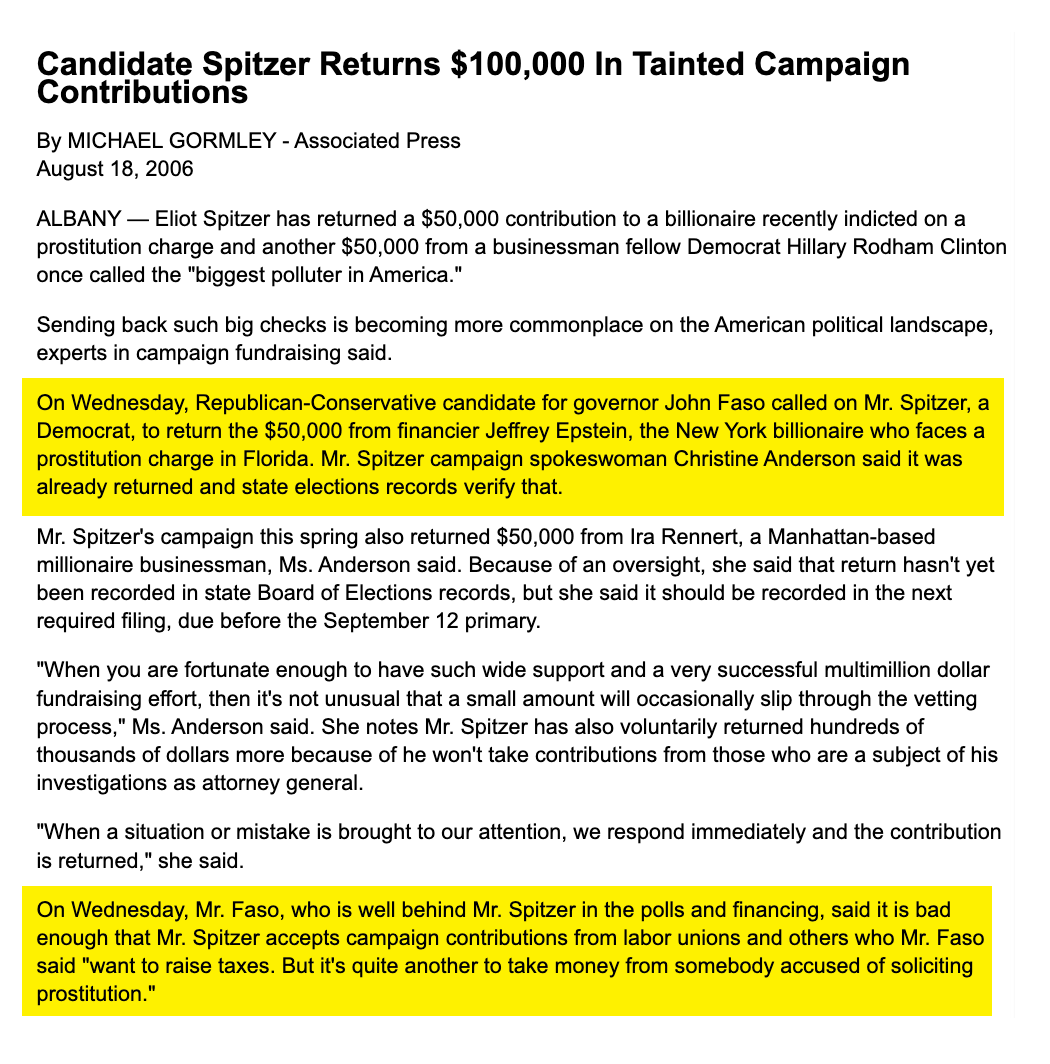
In another lovely twist of fate, of which there are so many in this saga, Spitzer himself would later have to resign over his own “prostitution” snafu. I continue to hypothesize that if the same set of circumstances transpired in 2026 — a Governor caught patronizing a high-end escort service — he would at minimum get promptly sued for “trafficking,” and perhaps even wind up criminally charged. (It’s also unclear how the Associated Press determined Epstein was a “billionaire” in the above 2006 article. This was never true, as far as the evidence has ever shown. He was plenty rich, just not a billionaire — when they arrested him in July 2019, his lawyers declared to Judge Richard M. Berman that his “total assets” were $559 million. For what it’s worth.)
Since we’re reflecting on the somber July 2019 indictment anniversary, another thing nobody seems to appreciate is that even at a very early stage of the federal re-prosecution, Epstein’s lawyers had already assembled a slate of credible arguments which were at least going to be facially plausible as they sought to contest his indictment. These arguments included the government’s brazen abrogation of the Non-Prosecution Agreement, or “Sweetheart Deal” in the dumbed-down Julie K. Brown / Netflix parlance. The text of the NPA had plainly stated that the NPA’s overarching purpose was to “globally resolve [Epstein’s] state and federal criminal liability,” as pertaining to matters the Feds had investigated in 2006-2008. Epstein went on to satisfy the conditions enumerated in the agreement: he pled guilty to the mandated Florida state charges, he served a term of incarceration, he registered for life as a sex offender, and he agreed to another highly “novel” and convoluted mechanism for paying civil restitution to the 30 or so individuals whom the government had claimed, but not proven, were his “victims.” And then eleven years later — poof. Under sustained political and media pressure, the Feds suddenly renege on their ostensibly binding deal, and start concocting an elaborate rationalization for why the NPA was actually never a “global resolution” at all, and Epstein could be permissibly re-prosecuted in 2019 — including for some of the very same conduct the Feds had already investigated over a decade prior, and for which he was expressly supposed to have been relieved from any criminal liability. That was the whole point of the friggin’ NPA! Does anyone seriously think Epstein’s stupendously expensive legal team of nationally-renowned defense attorneys would have inexplicably acceded to a “deal” — after months and months of arduous negotiations — if it had been made remotely clear to any party involved that this “deal” could just be summarily voided at a moment’s notice, and at the government’s arbitrary discretion?
Now, it is true that in 2018-2019, the Southern District of New York did at least some original investigation that might have not completely overlapped with what the Southern District of Florida had already investigated in 2006-2008 — giving SDNY prosecutors some remote semblance of an argument to claim they were not just shamelessly contravening the still-in-effect NPA. In particular, they shifted their investigative focus to offenses Epstein purportedly committed in New York, although even that aspect is highly questionable as to the NPA’s applicability, since the glorious 2026 “Epstein Files” have enlightened us with records detailing how SDFL prosecutors actually made previously-undisclosed treks to New York for investigative purposes in 2008. Which is a fascinating wrinkle I’ll have to expand on at a later date. For now, the point is that the NPA issue was highly contestable and unresolved as of July 2019; Epstein’s lawyers had perfectly sensible arguments at their disposal, and every reason to let them play out in the courts. Meanwhile, the government’s argument was chock-full of backwardly-reasoned mental jujitsu, a transparent post hoc gambit to justify how they could acquiesce to political/media clamor and finally put Epstein away for good — NPA or no NPA.
Clearing the NPA hurdle would’ve been necessary for the Feds before they even got to any of the other big evidentiary or statutory “challenges” — like the applicability of the TVPA to offenses the indictment alleged took place at least 14 years prior. Strangely, SDNY prosecutors couldn’t find any illicit sexual contact from the years 2005-2019, which you’d think would’ve been trivially easy if Epstein was really the most prolific pedophile predator to ever walk the earth. Genuine child-sex superpredators presumably lack the impulse control to contain their predatory urges — that’s why it’s believed they need to be locked up — whereas Epstein, by all accounts, demonstrably did modify his behavior starting in 2005, when Palm Beach police first launched their investigation, and he was never again accused in a criminal or civil context of illicit sexual activity with anyone under 18. So the Feds were stuck making a case based on allegations of conduct that was nearly two decades old at that point. They’d have to show Epstein violated the TVPA by “causing” persons under 18 to engage in “commercial sex acts” — which might seem eminently doable given Epstein’s reputation, but then again, the lead detective in the local Palm Beach phase was on record averring that none of the conduct he ever investigated met the standard for a “commercial sex act.”
The Feds would also be stuck with the original statutory language of the TVPA, way back from the year 2000, which could also have given Epstein some lines of defense. Though he admitted sexual interactions with persons who had not yet attained the age of 18, he always maintained he had never consciously known any of these persons were under 18 — and in fact he had believed they were all at least 18. There was significant evidence his defense team could marshal to this effect. Some of which we only now know about thanks to the glorious 2026 “Epstein Files” — and no, not the “files” that the podcast geniuses have dwelled on. For example: previously non-public testimony by Haley Robson, the adult female who has long acknowledged she’s the one who propositioned 14-year-old Saige Gonzales to perform a wonderful “massage,” and transported her to Epstein’s house for this purpose — the fateful 2005 event that prompted Palm Beach police to investigate. Haley told a federal Grand Jury on April 24, 2007 that Epstein “never told me to go find underaged girls.” Her standard practice, she explained, was to instruct the girls “that if they are underage, just lie about it and tell him that you are 18.” Which is precisely what Saige Gonzales subsequently did, after Epstein explicitly asked her how old she was during their one lovely liaison together. And she explicitly told him she was 18, even though she was actually 14.
The defense had lots of other evidence on this theme. Because when the Feds had first considered “trafficking” charges against Epstein, it was seen as a major impediment that a substantial number of girls Epstein could theoretically be charged with “trafficking” had openly lied about their ages, admitted as much, and also advised one another to lie about their ages if they were not yet 18. Among the biggest “challenges” in this regard was a purported victim named Tatum Miller, who had steadfastly denied she was even a “victim” — despite at one point receiving an FBI “Victim Notification Letter” — and was adamant that she saw no reason why Epstein should be prosecuted, because she believed he had done nothing wrong, and was an “awesome guy.” (Direct quote.) Tatum told the FBI in an April 25, 2007 interview that she was originally introduced to Epstein by Carolyn Andriano, who had approached her one day and said “Hey, would you like to make a couple dollars. And I said sure.” Carolyn explained that she knew this fellow named Jeffrey who lived on Palm Beach Island, and she’d been bringing girls over there to give him friendly massages. “Well, what about my age?” Tatum recalled asking Carolyn — since she was 16 years old at the time. “[Carolyn] said well, just make sure that you tell him that you’re 18. And I had a fake ID at the time and we went there.” Asked by the FBI agents to expand on why she was concerned that her age could be a problem, Tatum said: “I was young and I was pretty stupid and I didn’t want to get — I didn’t want to get in trouble. So I always made sure — I had a fake ID, anyways, saying that I was 18. And she [Carolyn] just said make sure you’re 18, because Jeffrey doesn’t want any underage girls.”
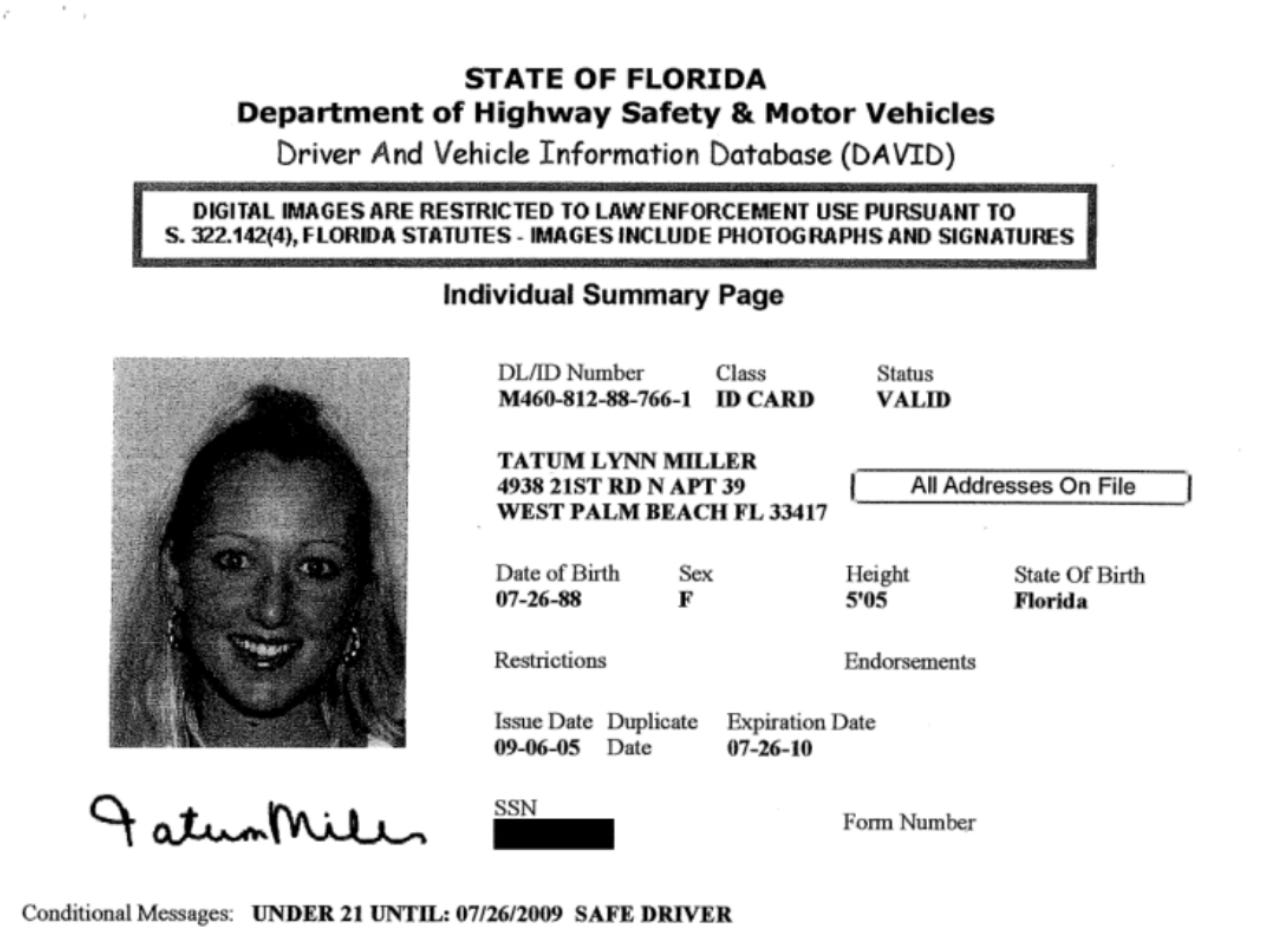
It’s not 100% clear from the 2019 indictment if the Feds were planning on resurrecting Tatum or Carolyn as victim/witnesses, but their victimization had always been alleged to have taken place exclusively in Palm Beach, and indictment does sprinkle in some ancillary Palm Beach allegations, even though it was mostly focused on New York to ostensibly circumvent the Florida-centered NPA. We know the Feds did eventually resurrect Carolyn as a marquee witness against Ghislaine Maxwell; she testified at Maxwell’s 2021 trial, and declared in open court that she was actively schizophrenic, claiming to hear voices inside her head that were threatening to come “sex traffic” her children. In 2023, Carolyn died of an apparent drug overdose. So if the Feds did plan for Carolyn to be their Palm Beach-based victim for an upcoming Epstein trial, they would have had to deal with her fellow “victim” Tatum potentially being called to explain why she had previously told the FBI that Carolyn was the one who first recruited (or “trafficked”?) her to Epstein — and had told her to lie about her age, after which Tatum followed suit and told numerous additional girls to lie about their ages. The prosecution would also have to contend with some other interesting disclosures from Tatum’s 2007 interview, which featured the hard-charging SDFL prosecutor Marie Villafaña, flanked by the two primary FBI agents working the Epstein case. Villafaña asked Tatum if there were “some types of girls [Epstein] really liked and others he didn’t like? Did he have any preferences in terms of blondes, brunettes?”
“He liked girls like me,” Tatum replied.
“Okay,” said Villafaña. “Thin and attractive?”
“I guess, yeah,” said Tatum. “Very attractive women. And he didn’t say girls. He said women all the time.”
Awkward.
One of the FBI agents sitting in on this interview, E. Nesbit Kirkendall, herself testified before the federal Grand Jury on May 8, 2007, and was asked about the girls brought by Tatum to Epstein. “They were all told to say they were 18,” Kirkendall verified. “But not on every occasion would Mr. Epstein inquire about their age.” Hmm.
Why would this be relevant for the purposes of convicting Epstein under the TVPA? Because again, the Feds would have to go by the original statutory text, as enacted in 2000 — that’s the version that would apply to offenses purportedly committed between 2002 and 2005. And the original language of that statute specifies that to be guilty of “child sex trafficking,” a person must have “knowingly… caused” an under-18 person to engage in a “commercial sex act.” Proving this would require establishing some degree of mens rea on Epstein’s part — that he consciously “knew” a particular girl was not yet 18, but still “knowingly” caused her to partake in a “commercial sex act.” The defense had reams of evidence to refute the government’s contention that Epstein had consciously known certain girls were under 18. BUT TO BE FAIR — other evidence also existed indicating Epstein indeed might have “known,” at least in some instances, that a particular girl was under 18. After all, he did plead guilty in 2008 to the federally-mandated Florida state charge of “PROCURING PERSON UNDER 18 FOR PROSTITUTION,” which related to one girl, Ashley Davis, who did credibly tell both Detective Joseph Recarey and a Florida Grand Jury that over the course of their approximately 15 sexualized encounters, Epstein had become aware she was 17 years old.
My point here is not to proclaim with unbridled confidence that Epstein would have achieved a favorable disposition of the 2019 criminal case: that he would’ve gotten the charges dismissed on legal/technical grounds, or found Not Guilty if it had gone to trial. He ended up dead, as you might have heard, so we’ll never know. The SDNY in all likelihood could have come up with some way to safely convict him, aided by the surrounding political and media rancor. They were able to convict Ghislaine Maxwell on arguably even flimsier grounds. So here is my point: the 2019 federal case against Epstein was not nearly as “slam dunk” as everyone just reflexively assumes. Remember, this was Maurene Comey & Co. splicing together another characteristically “novel” application of the infinitely-elastic TVPA statute. That elasticity can be a huge advantage for prosecutors much of the time, but not always — nobody knows what the hell “trafficking” even is anymore, except insofar as prosecutors seek to fit it with their own set of preferred facts, and sometimes their efforts go off the rails to the point that jurors’ credulity is exhausted. (See: Diddy). In the Epstein case, the Feds would’ve had a much easier time nailing him on “trafficking” charges if his inculpating conduct had allegedly occurred in, say, 2016-2019, rather than 2002-2005. Congress passed a major amendment to the TVPA statute in 2008, which vastly reduced the government’s operative burden of proof. Whereas the government was previously required to establish that a “child sex trafficking” culprit had knowledge of a victim’s true age, this requirement was abolished thanks to the pompously titled “William Wilberforce Trafficking Victims Protection Reauthorization Act of 2008.” Upon passage of this Act, the government now needed only to show that the “child sex trafficker” had a “reasonable opportunity to observe” an under-18 victim — in which case, it no longer needed to be proven “that the defendant knew that the person had not attained the age of 18 years.” And voila: any annoying obligation to establish mens rea was effectively eliminated. Luckily for Epstein, this sweeping statutory overhaul post-dated all his charged conduct! Check out the “Ex Post Facto” clause of the US Constitution sometime.
Could they still have put him away, notwithstanding any of these pesky complicating factors? Yeah. They definitely could have. But the popular folklore around the open-and-shut inevitability of his guilt being proven, beyond a reasonable doubt — like most things Epstein-related — is almost entirely a function of pervasive low-info mythology, rather than any informed examination of the relevant facts and evidence.
The big twist of this article is that I haven’t even gotten to the most mind-boggling deficiency in the 2019 indictment — one that should massively upend any rational person’s assumptions about what could or could not have been proven. This isn’t some peripheral issue, either — it goes straight to the core of what the Feds chose to hinge their entire case on. Because new evidence has emerged that certainly casts things in a phenomenally different light. These revelations will have to wait for another day, though. For now: Happy Epstein Indictment Anniversary. I don’t know of any other significant national anniversaries coming up, so this is an appropriate one to celebrate.
Michael-have you considered turning all your research into a book? I could imagine challenges finding a publisher, but at least this subscriber would be interested in purchasing compendium of yours on this topic.
Will the rapidly exfoliating and vehemently believed Epstein conspiracy phenomenon, complete with savage attacks on anyone daring to objectively examine the actual knowable facts of the case, one day go the way of Russiagate? Five years from now how many will be saying, "Oh, I always knew it was a fake. Never made much sense."