


When Congress passed the Trafficking Victims Protection Act of 2000, it was hailed as a monumental step forward in the critical fight against “modern-day slavery.” And who could possibly be against fighting slavery? Our history class textbooks might have taught us we got rid of it during the Civil War, but sometime around the turn of the 21st Century, an impressively diverse cross-section of NGO activists, politicians, and law enforcement officials began gravely informing the public that “slavery” never actually went away, and in fact remained shockingly pervasive. Resolute action, they explained, would be needed at once to stamp out this hidden scourge.
The phrase “modern-day slavery” thus entered wide circulation as the default image meant to be associated with “human trafficking” — a term which itself does not necessarily carry any clear-cut definitional reference. Most people in the year 2000 probably would have been familiar with “drug trafficking,” as in the large-scale transport of illicit drugs, but it wasn’t so straightforward what the illicit transport of “humans” or “sex” might mean, as opposed to the “trafficking” of controlled substances or other inanimate objects. Hence, there would need to be a highly concerted effort to educate the apparently clueless masses, such that when Joe or Jane Schmo would hear someone cry out “human trafficking!” — or its popular subcategory, “sex trafficking!” — they would immediately call to mind the most grisly manifestations of “modern-day slavery.” Which is to say: something really, really bad. Bad enough that any decent person would be utterly appalled it could still exist at such staggering proportions, and worse, that society has been so complacent, or even outright complicit, in its grotesque perpetuation!
This was an effective bit of rhetorical strategy by the burgeoning activist consortium. Because to invoke “human trafficking” would soon conjure the most harrowing visions of 11-year-old girls being held in depraved sex captivity, perhaps somewhere in the frightful foreign dungeons of Thailand or Guatemala. Such images were supposed to especially resonate with Americans, because it was said that these poor hypothetical girls were being systematically shipped to the United States, like chattel for Pete’s sake, and then farmed out to our homegrown deviants for sick sexual gratification. And hey, you never know, maybe the helpless trafficking victims are right around the corner from your local Panera Bread, getting viciously raped while you enjoy your Chicken Frontega Panini. That these mass enslavement practices could be allowed to persist, including in our own affluent suburban backyards, was so intolerable that it necessitated a panoply of ambitious interventions — not least endowing the state with expansive new prosecutorial powers. Only then could we have any hope of abolishing the last shameful vestiges of “slavery.”
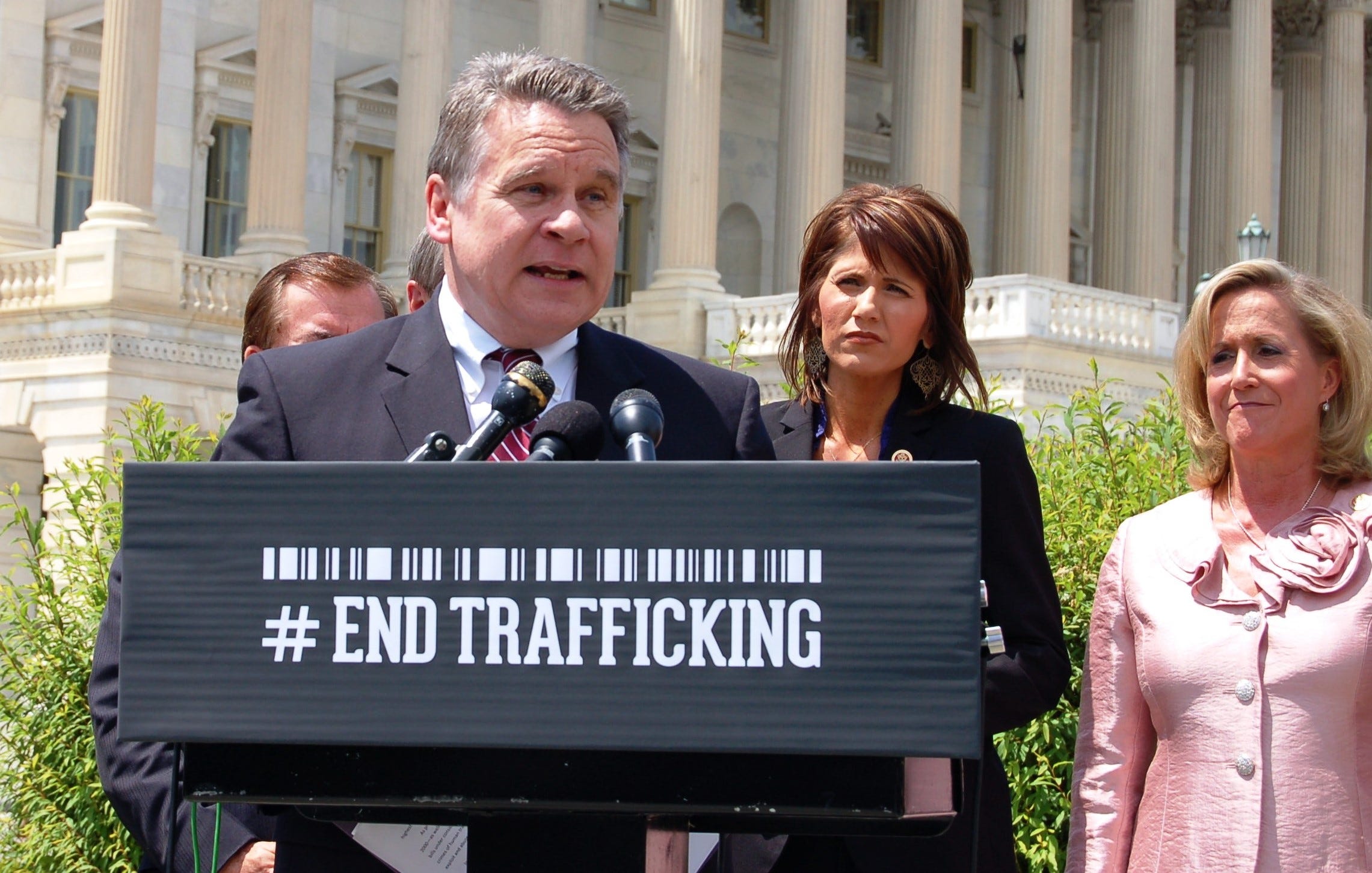
Chris Smith, a Republican Congressman from New Jersey, was the chief sponsor of the Trafficking Victims Protection Act (TVPA) — and wouldn’t you know it, he’s still in the House to this day, getting ready to seek his 25th consecutive term in November. So congratulations on the undoubtedly well-deserved longevity, Sir. “My legislation was designed to give our government the tools we believed it needed to eliminate slavery, and particularly sex slavery,” Smith said on the House floor in a November 29, 2001 speech, reflecting on the one-year anniversary of his landmark bill’s passage. “The central principle behind the TVPA is that criminals who knowingly operate enterprises that profit from sex acts involving persons who have been brought across international boundaries for such purposes by force or fraud, or who force human beings into slavery, should receive punishment commensurate with the penalties for kidnapping and forcible rape.”
Foreign criminal gangs capturing beleaguered women and girls, and then coercing them into sex bondage for profit, remained the popular imagery associated with “trafficking” well into the 2000s. When the George W. Bush administration occasionally highlighted its own “anti-trafficking” efforts, the emblematic victims it described would be toiling in conditions of quintessential “servitude” — women and children “trafficked against their will across international borders,” then smuggled surreptitiously into the United States, for “servitude” such as “prostitution, sweatshops, domestic labor, farming, and child armies.” While the government never appears to have located any purported “child armies” marching across Missouri or whatever, if they were insisting additional authorities were needed to thwart organized crime of similar depravity, who was going to object? This stuff sounded like pure hell on earth, and somehow the American People had been letting it go on right under their noses!
Setting aside the specific details — such as the actual prevalence of this alleged “trafficking” crime wave, or what any forthcoming enforcement actions would exactly consist of — surely, in the main, a broad-based collaborative effort by the private and public sectors to unite against “trafficking” was a uniquely heartening example of everyone finally getting together to do something uncontroversially virtuous, notwithstanding other differences on political or cultural issues. Surely, this was something on which we could all enthusiastically agree! And while such instant, unexamined consensus might be seen by the more cynical among us as a bit of a red flag, nevermind that — the government and their NGO “partners” are proclaiming there is so much to be done, NOW, to expeditiously to crack down on “modern-day slavery.” So let them get to work!
It would not be an exaggeration to say that in the 25+ years that have elapsed since the passage of the TVPA in 2000 — when “trafficking” really first became a “thing,” having been reified with a comprehensive new statutory framework — a quiet revolution has been unleashed across American law and culture. What makes this revolution extra astonishing is how chronically under-recognized and under-scrutinized it is — hence, the eerie “quietude.” Certainly for the poor saps who wind up getting caught in the web of hyper-punitive “anti-trafficking” consensus, the consequences can be anything but “quiet,” except perhaps for occasional moments when the noise abates in their prison cell. And though some fleeting attempts have been made to shout from the hilltops about how “trafficking” has strayed so outlandishly far from its original inception as enumerated by Congress, the shouting tends to fall on deaf ears — because who wants to “defend” a “trafficker”? And if you’ve been designated a “child sex trafficker”? Forget it. Might as well just screech into the void.
The “trafficking” revolution has accelerated greatly over just the past decade or so, and even arguably within just the past handful of years. The public has simply not been made aware of how the conduct that now gets routinely charged and labeled as “trafficking” bears zero resemblance to anything a normal, sane person would have understood as “trafficking” when the concept was first introduced at scale — that is, the paramount form of “modern-day slavery,” the continued existence of which was supposed to shake us all to our core. Indeed, the limitless conceptual expansion of “trafficking” has gotten so extreme that it’s now virtually impossible for anyone, including those in positions of serious public authority, to put forward a modestly coherent description of what “trafficking” even is — if they ever could. While the definitional criteria have always been deliberately vague, and therefore ripe for generous modification over time, the original depiction as ruthless, organized sexual subjugation has been so severed from the present-day formulation that we might as well be talking about entirely unrelated phenomena, requiring an entirely novel set of descriptive devices.
The obsolete notion that the government’s crusade against “trafficking” would entail tracking down hardened criminals who “knowingly operate,” for financial gain, monstrous commercial sex rings of enslaved women and children — that’s now just a bad joke, and a very unfunny one for those who’ve been ensnared by the new “trafficking” apparatus. Forget the prototypical preteen girls held in squalor, then smuggled across borders to provide forced sexual services: that’s gone, even though it was the mental image initially promulgated to convince all conscientious citizens they should be inordinately concerned about “trafficking,” and should acquiesce to the adoption of sweeping new retributive state powers. Today, a more typical “trafficker” is someone who haplessly chats to a police decoy on an app, or offers “intangible entertainment” in exchange for some potential sex act, or unwittingly “grooms” an adult woman by engaging in playful banter. Truly, it would not be much of an overstatement to say “trafficking” can now mean anything and everything, and is squarely in the eye of the beholder — namely prosecutors and plaintiff’s attorneys. If there is a more drastic example of government-backed “concept creep” in recent decades, I’ve yet to encounter it.
These revolutionized concepts of “trafficking” have been woven throughout virtually all layers of contemporary statecraft. Following the TVPA’s enactment in 2000, states began to draft their own “anti-trafficking” laws — often featuring even more porous definitional criteria than the federal model. Frequently, these measures were sprinted to passage without any appreciable debate at all, thanks to the gloriously bipartisan consensus that emerged — and anyway, what politician in their right mind would “debate” the merits of going after ghastly “trafficking” criminals? In 2003, Washington State and Texas became the first to adopt standalone “anti-trafficking” statutes. By 2013, all 50 states had followed suit, with Wyoming the final straggler. This is rather astonishing when you think about it, because until 2003, no state had a single such “anti-trafficking” statute. So we’re supposed to believe that before the year 2003 — basically the Stone Age, I guess — each and every American state, from the most compassionately “progressive” to the most law-and-order “conservative,” was tacitly condoning the mass-scale perpetration of “modern-day slavery.” But then, by 2013, they all achieved enlightenment, and realized slavery was bad.
Even among the states that were relatively early in passing this critically important legislation, actual enforcement of “trafficking” law remained sporadic throughout the 2000s. For a time, it seemed like these trafficking measures were mostly symbolic, with unclear practical impact — basically just a way for lawmakers to uncontroversially affirm their profound moral revulsion toward “modern-day slavery.” The same was roughly true at the federal level. In fact, the conspicuously minimal enforcement of the TVPA was what compelled Chris Smith to deliver his November 2001 floor speech, wherein he complained: “Like all laws, however, this law is only as good as its implementation. And, frankly, I have been deeply concerned at the slow pace of implementation of the TVPA… I do not say this to complain or criticize. I know that many things move too slowly in the first year of a new Administration, and that since September 11 our attention and resources have been diverted elsewhere, but to emphasize that from now on, we do not have a minute to spare.”
Smith’s dire warning that there was not a “minute to spare” stirred negligible buy-in at the time, at least compared to the prerogatives of the newly raging “War on Terror.” But by the 2010s, “terrorism” had largely receded as an all-consuming national preoccupation, and Smith would get his long-awaited wish. You might even say a “War on Trafficking” was declared, sometimes literally, but more often through the steady accumulation of legal and NGO infrastructure, undergirded by a profusion of “trafficking”-related academic jargon — the makings of what today has become an enormous full-fledged “anti-trafficking” industry, so vast and multi-disciplinary that it’s essentially impossible to quantify with any precision, not that 99% of the media and political class would be interested in doing so anyways. Like other makework industries in which professional livelihoods, credentials, and grant monies are at stake, the “anti-trafficking” industry is self-perpetuating and self-fulfilling, and subsists on the continual ever-presence of an acute “trafficking” menace. Thus, there is every incentive for industry participants to classify more and more conduct, of greater and greater variety, as within the ambit of “trafficking.”
The first administration of Our Favorite President, Donald J. Trump, once claimed it was on a righteous mission to “eradicate” trafficking — except to eradicate “trafficking” these days would be akin to eradicating “misfortune” or “unkindness,” or some other intrinsic vagary that does not consistently correspond with anything in particular. So nebulous has the concept of “trafficking” grown that although it can be ostensibly defined by reference to various federal, state, and municipal codes, the typical wordage has been so creatively interpreted and re-interpreted that the relevant statutes now pretty much function as a catch-all license for prosecutors to define “trafficking” however they want, whenever they want, against whomever they want, in their infinite humanitarian wisdom, based on whatever exigent circumstances may arise.
Take, for instance, Mark Alan George of Ohio, a poor sap who had the extreme misfortune of logging onto a website called “Skip the Games” on January 5, 2024, and responded to an advertisement for sexual services that appeared to have been placed by an adult woman, but was actually Mahoning Valley Human Trafficking Task Force Agent Joe Chamberlain. George, then age 37, agreed to pay $100 for oral and vaginal sex, and arrived at an agreed location in Salem, OH. At which point he was promptly arrested and charged with violating section R.C. 2907.231(B) of the Ohio criminal code. The law, which had just been revised in 2023, prohibits engaging in “sexual activity for hire” — defined as any “implicit or explicit agreement to provide sexual activity in exchange for anything of value paid to the person engaging in such sexual activity, to any person trafficking that person, or to any person associated with either such person.” Which, as usual with these kinds of statutes, is quite an inscrutable mouthful. Although the crime George was convicted of is technically titled “ENGAGING IN PROSTITUTION” for shorthand, it had just been updated to comport with the latest frontiers in “trafficking” theory. George was also busted by a self-proclaimed “Human Trafficking Task Force,” of which there are now countless operating in the United States, with steadfastly opaque authorities and command structures, and which mostly seem to sit around manufacturing otherwise non-existent crime under the guise of heroic “trafficking” interdiction — even as we’re constantly told “trafficking” is so incredibly rampant that there’s such a pressing need for these “Trafficking Task Forces” to exist in the first place, and of course be plentifully funded by taxpayers.
To his credit, George at least had his lawyers challenge the Ohio law on Constitutional grounds, for “vagueness” and other infirmities. It didn’t succeed, but some useful questions were still raised. “What is an ‘implicit agreement’?” his lawyer, Ronald D. Yarwood, justifiably asked in a court motion that is worth reading (see file below). “No one really knows,” writes Yarwood. “The statute is written in such a way that one must wait and see if they went too far in the eyes of the government officer who levels the charge. Ohio’s engaging in prostitution statute as written is impossible for a person of average intellect to know what is lawful and what is not.”
He goes on:
As written, R. C. 2907.231 criminalizes what would be considered as generally accepted courting, dating, and marriage norms. All relationships carry implicit and explicit agreements between the couples to provide various services of value to one another. It could be moral support, financial support, companionship, love, and physical intimacy. Even conventional marriage vows include implicit and explicit covenants. Many conventional relationships between couples that lawfully have intimacy with one another would fly afoul of R. C. 2907.231 simply because during the relationship one offered the other anything of value in exchange for receiving sexual activity. Even “unconventional” relationships between consenting adults are lawful - for instance, one-night stands, multiple participant relationships, “friends with benefits” and the list is truly limitless. Individuals have a due process right to have engage [sic] in private sexual conduct. See generally, Lawrence v. Texas, 539 U.S. 558 (2003). Therefore, any statute attempting to limit an individual’s lawful right to exercise their liberty is unconstitutionally overbroad. During any of these types of relationships inevitably at some point no matter how fleeting, there will be an implicit or explicit offer to provide anything of value in exchange for sexual activity.
Ultimately, as written there is an arbitrary enforcement of the statute based on the whims of the government. This cannot stand.

I fail to see where this argument is wrong on the substance. I also fail to see what public interest is served by the police trolling adult-only websites to nab lonesome lads like Mark Alan George, who are seeking run-of-the-mill transactional adult sexual activity, and then charging them with convoluted crimes which, while technically a “prostitution” offense in this case, vaguely carry the tarnish of a “trafficking” offense. Nor do I see why the state has any business criminalizing what it calls “implicit agreements” between adults who may engage in sexual contact for “something of value,” especially since, as we will see, a “thing of value” can also increasingly mean everything and nothing. Our unfortunate defendant here did apparently offer to exchange actual US currency for his intended sex acts, which puts his conduct more squarely in the remit of what would be considered a classic “prostitution” offense. But even if you think it should rightfully be a huge priority of the state to pour extensive taxpayer resources into nailing guys like George for their quintessential “prostitution” conduct — by having cops creepily pose as ladies on adult hookup sites — it’s still extremely unclear why, in order for the state to carry out this very important task, it would also be necessary to criminalize “implicit agreements” between consenting adults who, over the course of facilitating some sexual interaction, may at some point “implicitly” exchange a “thing of value.” This seems to give the state way too much discretion to intrude on the private affairs of otherwise law-abiding citizens, and moreover, there is no obvious “public safety” rationale either, if you have to get so semantically bizarre about the elements of “prostitution” or “sex trafficking.” Because if there’s a legitimate victim to rescue, you’d think that would be easily discoverable for any commonsense investigator, without having to divine what “implicit” agreements may or may not have been made.
This all gets to why whenever someone asks me whether or not something is “trafficking,” such as related to allegations against Jeffrey Epstein or Ghislaine Maxwell — or increasingly, anybody else — I have no choice but to hedge, contest the premise, and deny that “trafficking” is something that has any stable definitional criteria any longer, if it ever did, because it’s impossible to know what we’re even talking about anymore when we use the word “trafficking.” People just do not know, or do not care to know, how radically the contours of “trafficking” have expanded in only the past several years — with impressively little debate, oversight, or critical interrogation in the legal/academic literature, much less in the political arena, where the glorious bipartisanship prevails. Here’s another noteworthy example, having to do with someone slightly better known than the poor sap in Ohio:
In August 2018, it was ruled that Harvey Weinstein could be held civilly liable for “sex trafficking” offenses by a federal judge in the Southern District of New York, Robert W. Sweet, who, it should be noted, was 95 years old at the time, having been first appointed to the bench by Jimmy Carter. Sweet would unsurprisingly die the following year. Still, he was apparently thought lucid enough at the time to opine that Weinstein was culpable for violating the federal TVPA, and therefore culpable for sex trafficking violations, because in 2014, he was alleged to have invited an actress named Kadian Noble to his hotel room at the Cannes Film Festival, as the two had made plans to view her “film reel” together. Over the course of this appointment, Weinstein allegedly groped the woman’s breasts and masturbated himself. What transformed the sequence of events into “trafficking,” so the theory went, was that Weinstein had offered the woman “something of value” — whereupon a “commercial sex act” was created, and Weinstein had engaged in “sex trafficking.”
The “thing of value” in this case was Weinstein prospectively offering to help Noble’s movie and modeling career. Noble was deemed a legitimate “trafficking” victim in the eyes of the law, per the aged Judge Sweet, because she claimed to have “felt compelled to comply” with Weinstein’s sexual requests, owing to the “tangible and intangible benefits [Weinstein] offered to advance her career,” and the benefits she could prospectively “receive from a favorable relationship with him.” This is what purportedly coerced her into submission. And so, American jurisprudence transmogrified “trafficking” from the most savage form of “modern-day slavery” to situations where an adult actress consentingly engages in sex acts with a prominent movie producer, in hopes of advancing her career, but when the desired career advancement does not pan out, she retroactively declares herself to have been “trafficked,” and seeks millions of dollars in compensation. This was determined by the 95-year-old jurist to be a sound application of the federal TVPA statute. Which on one level is just hilarious: the idea that back in 2000, when Congress was drafting this landmark law, a single one of them ever seriously contemplated that it could encompass such activity as alleged by Miss Noble. In his October 28, 2000 signing statement (just before that year’s presidential election, interestingly), Bill Clinton had trumpeted all the usual cliches, boasting that “the Act’s anti-trafficking provisions represent a major step forward in my Administration’s ongoing effort to eradicate modern-day slavery.” Fast-forward to the not-so-distant future, and what the Act was actually being used to “eradicate” were perhaps sleazy, if unremarkable, luxury hotel room rendezvous between adult actresses and producers at the glitzy Cannes Film Festival in the south of France.
Weinstein’s lawyers tried in vain to argue that nothing Weinstein was accused of doing bore the slightest bit of resemblance to what Congress had said the TVPA was for — creating “a comprehensive regulatory scheme that criminalizes and attempts to prevent slavery, involuntary servitude, and human trafficking for commercial gain.” The lawyers contended that any attempt to shoehorn Weinstein’s alleged hotel room behavior into a “trafficking” violation would represent “a novel and expansive interpretation of the Trafficking Statute for which there is no precedent.” They were entirely correct on this score, but they perhaps failed to anticipate that the ailing Judge Sweet was eager to invent just such a precedent. “It is fair to say that these allegations present an extension of an element of [the TVPA] on which there is little to no prior authority,” wrote the geriatric judge. “What follows is an effort, aided by the tools of statutory construction, to navigate these uncharted waters.”
Indeed, if the “uncharted waters” were ever going to be “navigated,” the perfect catalyst for doing so would be the supremely villainous Weinstein, on whose behalf there would be no public sympathy marshaled, even if he was being used as a test case for a radical new interpretive paradigm that would thenceforth affect the entire population. Mega-villains like Weinstein, and later Epstein, are perfect foils to inaugurate these inventively “novel” legal precedents, because everyone is expected to be so mandatorily repulsed by them that thinking critically about anything they’ve been involved with is strictly forbidden. Thus, the theory debuted by Judge Sweet in 2018 was especially far-ranging. Weinstein’s lawyers had tried to point out that by the time Noble filed her TVPA lawsuit, the statute of limitations had expired on any “traditional sexual assault claims” she might have brought. But the statute of limitations for “trafficking” was much more permissive, thanks to a provision of the TVPA that was nominally intended to give “slavery” victims appropriate latitude to seek civil remedies against their enslavers. Noble and her lawyers made clever use of this provision to “create a jurisdiction in the United States” for a sex act that allegedly took place in France — by describing the hotel room liaison as a crime scene of Weinstein’s international “sex trafficking” venture. Noble purportedly being assured by Weinstein that “everything would be taken care of” regarding a possible future movie role was transformed into a binding “false promise” under the TVPA, as this would satisfy the “force, fraud, or coercion” element of the statute. Judge Sweet found that in the months and years following the hotel room encounter, “no actions were taken by Harvey to further Noble’s career as an actress or model” — so even though she had “complied” with his sexual entreaties, she had only done so on the fraudulent understanding (or “false promise”) that this would eventually result in Harvey making her a star on the silver screen. “Although Noble saw Harvey three times after the alleged 2014 sexual assault, no film role materialized,” according to a summation by the soon-to-be-deceased Judge Sweet. Imagine that! This adult woman went back and “saw” her trafficker and/or assaulter on at least three additional occasions following the traumatic “trafficking” incident. Surely, that’s another key detail every normal person in 2000 would have intuitively recognized as dispositive of “trafficking.” (Did she “traffic” herself on those subsequent three visits???)
Judge Sweet, in his enfeebled wisdom, did at least acknowledge that Noble’s claims were “not an archetypal sex trafficking action,” but he nonetheless determined that Weinstein could be liable for “sex trafficking” violations per the TVPA. The “archetypal sex trafficking action” Sweet cited by way of contrast was a 2016 case involving an individual who allegedly “recruited vulnerable women” across several countries with false promises of modeling careers and other perks, only to “force numerous women into prostitution by beating them, humiliating them, and threatening to kill them.” Stipulating that the allegations in that case are true, for them to be lumped under the same statutory umbrella as what Harvey was accused of doing is a spectacular expansion of “trafficking” — and proves the term had evolved to a point where no one “trafficking” offense would ever again have to bear any necessary relation to another.
“Harvey effectively ended his relationship with Noble the moment he ejaculated on the bathroom floor,” Judge Sweet oddly remarked, because for him, this ungentlemanly cold-shoulder treatment showed Harvey had engaged in conscious “fraud,” sufficient to make him culpable for “trafficking.” Harvey himself did appear to concede there had in fact been some sort of intimate encounter with Noble, but he argued that any “promises of future benefits” he might have made to her, even if not ultimately fulfilled, were so “indefinite and vague” that they could not conceivably constitute a “commercial sex act” for the purposes of TVPA litigation. Diluting these statutory requirements, Weinstein’s counsel argued, “would unfairly expand the federal sex trafficking statute to all sexual activity occurring between adults in which one party holds a superior position of power and influence.” While this dramatic interpretation might not be totally accurate — yet — it’s at least in the ballpark of how trafficking law has indeed come to be so liberally applied. The traditional notion of a “commercial sex act” requiring a “thing of value” be exchanged — most commonly money, as in the case of that Ohio schlub — has been watered down and engorged into a vast conceptual ocean, far beyond the 2018 Weinstein precedent, which had only codified that a “thing of value” can be as little as an intimated offer of non-specified future career assistance. “For an aspiring actress,” wrote Judge Sweet, “meeting a world-renowned film producer carries value, in and of itself.”
As one would expect, in the years since this precedent was propounded, the applications have grown all the more expansive and unwieldy, including in the domain of criminal law. It would not be a major stretch to say that in 2026, a “thing of value” is more like an amorphous metaphysical condition than anything which must necessarily exist in the observable, material world. Here is what Judge Valerie E. Caproni instructed jurors in the trial of the Alexander Brothers in March 2026, as to what elements must be proven to establish a “sex trafficking” conspiracy:
The “thing of value” given or received in connection with the sex act need not involve a monetary exchange and it need not have any financial component; instead, it may be any tangible or intangible thing of value, including, for example, recreation or entertainment. The thing of value can be given to or received by any person, including the victim. Whether a thing has value depends on the recipient’s subjective view of the purported “thing of value.”
Got that? We’re so far past the “thing of value” needing to have any old-fashioned “financial component” that we’re hurtling deeper and deeper into the mystical realm of “intangibility,” where a “thing of value” can now be “recreation” or “entertainment.” Whatever that might mean to any given individual. But it doesn’t stop there! Whether the “thing” in question is seen as “recreational” or “entertaining” depends solely on the “subjective view” of the recipient — and is therefore immune to any non-subjective evaluation methods. You could theoretically give me a crumpled-up piece of scrap paper, or even a steaming hot pile of dog shit, and if I, as the “recipient,” subjectively perceive what you have given me as containing some intangible “value,” tough luck, because that would satisfy a crucial element of the “sex trafficking” statute. And oh, by the way, it doesn’t even have to be the “victim” who receives the valuable pile of dog shit! My dumbass friend could receive it, ascribe it with subjective value, and this could suffice to prove I was victimized in your “sex trafficking” conspiracy.
Going back to the Weinstein civil precedent, that the gambit actually worked is a credit to lawyer Jeffrey Herman, who represented the innovative trafficking victim Miss Noble, and is one of the most prolifically imaginative “victim” lawyers in all the United States. In fact, it was he — because there is always an Epstein connection with this stuff — who (of course) had been one of the earliest lawyers to track down purported Epstein victims in Florida, way back in 2008, for the purposes of using them to extract giant monetary settlements from Epstein, which partly set into motion the fateful chain of events that continue to rattle much of the world today. Wouldn’t you know it, a decade before his watershed “sex trafficking” action against Weinstein, Herman had gamely inserted himself into the saga of Saige Gonzales — yep, that’s right, the very Palm Beach girl whose onetime “massage” encounter with Epstein is what precipitated the initial 2005 police investigation against him. So, one could plausibly argue that Herman has been a startlingly integral player in multiple decisive pivot-points of the great “trafficking” revolution. And the more you look into this guy, the more you’ll have no choice but to conclude that if a character such as he could have exerted such far-reaching influence, any system that would’ve enabled this must be declared fatally unsalvageable, and razed to the ground. Really. I’ll substantiate this admittedly grandiose claim in much greater detail for a subsequent installment of my little “trafficking” series, so make sure to subscribe if you haven’t already — I can promise the carnival of insanities is boundless, and I’ve barely scratched the surface here. Dulled as my limbic system now is after getting so unhealthily immersed in this crap, I still manage to have my mind blown on a disturbingly regular basis by the depths of the insanity. If, after reading the series, you feel I have oversold the pitch, and have enticed you with a “false promise,” feel free to sue me for “trafficking” — you’ll probably win.
Ask people to define the major crimes-robbery, shoplifting, murder, carjacking, etc.-and you'll get uniformly correct answers. Ask people to define sex trafficking and you'll not only get wrong answers, you'll get a different answer from everyone you ask! Even people most hysterically obsessed with the notion couldn't correctly define it with a gun to their head.
In 2011, Virginia Giuffre writes a 100 page memoir where she uses the word trafficking just once to describe not Jeffrey Epstein but another man who was apparently smuggling in prostitutes from Eastern Europe. By the end of the decade, the word trafficking has morphed to a degree that Giuffre can claim to have been "trafficked" and be the very face of trafficking victims.
Great article, but I think it should have been published in a print magazine or Compact or Quilette.
The younger sister of a guy I know was charged with sex trafficking in Washington (I dont remember if she was convicted) and while I dont remember the details I remember at the time from the newspaper story it sounded a lot like they just went across the state with a prostitute they were doing heroin with.