

This is Part One in a multi-part ad hoc series. I don’t know how many parts there will ultimately be, so relax.
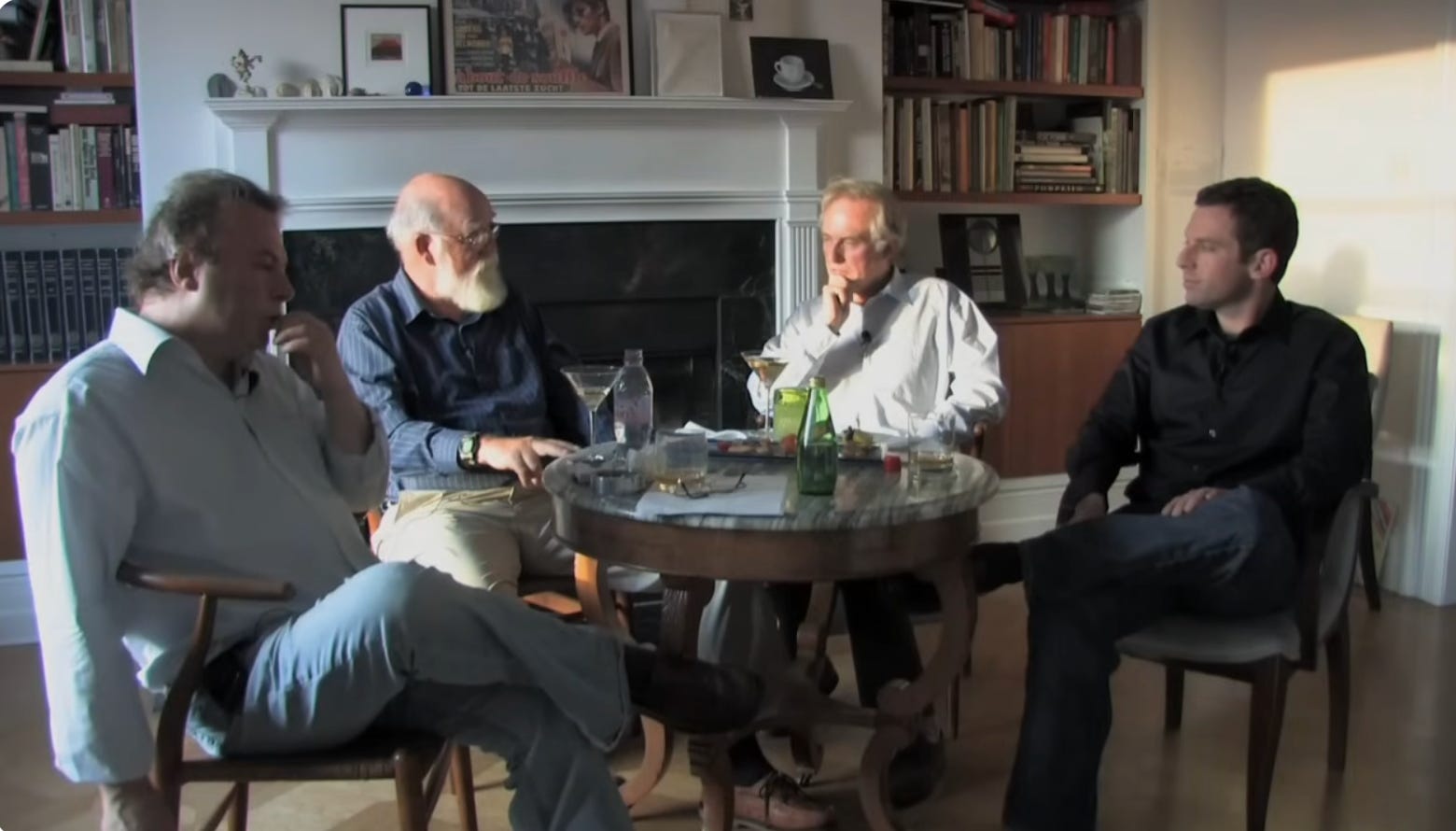
No, I’m not going to seriously argue that “we” should somehow “bring back” the particular brand of “New Atheism” that briefly gained popularity in the mid-to-late 2000s — mostly as a function of its association with a handful of high-profile figures like Richard Dawkins, Christopher Hitchens, Sam Harris, Daniel Dennett, etc. Whatever that phenomenon was exactly, it was very much specific to a bygone political and cultural era. Partly what catalyzed it was a burgeoning sense that various flavors of monotheistic zealotry had been allowed far too much sway in matters of “public discourse,” without any satisfactory rebuttal. This felt all the more irritating, because Americans who considered themselves atheists, agnostics, or otherwise irreligious had for some time been a rapidly growing demographic, and yet were conspicuously under-represented in the public arena, which still valorized traditional religiosity as a moral model to which all should aspire. The related idea that religious belief must be treated as sacrosanct, and therefore uniquely immunized from critique — even blistering critique where appropriate — was a taboo many saw as long overdue for some unapologetic jettisoning. Even if it might come at the expense of offending “people of faith,” another weird Bush-era coinage. And so into that void swept the “New Atheists” — with their brash personalities, media fluency, above-average vocabularies, and knack for stirring up rancor.
Some of the latent grievances that gave rise to “New Atheism” were perfectly defensible. I’ll admit that I personally harbored many of them, and eagerly inhaled all the best-selling “New Atheist” books. Yes, I have a signed copy of “God Is Not Great” by Hitchens. Yes, I watched all the early YouTube “debate” videos. And why shouldn’t I have? Questions around the existence or non-existence of God are always going to be thrilling on some level to contemplate, and publicly joust over. Because by golly, aren’t these supposed to be the most profound questions of all? Beyond the age-old philosophical arguments, it struck me as eminently sensible that reintroducing some form of muscular “secularism” to popular consciousness was a worthy endeavor, despite the unavoidable vagaries of what exactly that would entail.
Remember, this was a period when George W. Bush was seen to have turbo-charged the influence of politically-domineering Evangelical Christianity — with all its moralizing bluster, hostility to scientific advancement (“stem-cell research” was a big flashpoint then) and signature hypocritical censoriousness. Not to mention the War on Terror, and the Iraq War in particular, being routinely framed as a titanic “Clash of Civilizations” with apocalyptic religious overtones. Although ironically, it should be said that even during the headiest days of the G. W. Bush years, there was hardly anything as extreme as the Pete Hegseth prayer-tirades of late, in which the self-proclaimed “War Secretary” showily beseeches the Almighty to “pour out your wrath” on the Nation of Iran, and unleash “overwhelming violence” on their infrastructural assets, so that the United States Military might be empowered to “break the teeth of the ungodly.” It’s doubly ironic that this stuff is so in-our-faces today, because although Bush was himself a professing Evangelical, it’s almost impossible to imagine him countenancing such garish displays of blood-thirsty zeal, especially as sermonized with the imprimatur of the Pentagon. Conversely, no one in their right mind would associate Donald Trump with earnest piety of any sort, but he’s clearly got no issue allowing the Hegseth Holy War talk to flourish under his Administration. Perhaps this is in part because of Trump’s own personal apathy toward matters of the divine. I mean, for Christ’s sake, here’s a guy who just casually posted a brazen idolatry meme of himself in the visage of Jesus Christ — a straightforwardly heretical act if there ever was one, at least if you subscribe to a doctrine that regards such things as “heresy.”
Back in the “New Atheist” heyday, tracts like “American Fascists: The Christian Right and the War on America” were emblematic. I read that book, by the left-wing journalist Chris Hedges, around the time it came out in 2007; the thesis was basically that a menacing new Fascism was taking hold in America, and if we right-minded citizens didn’t get our act together, shock troops would soon be marching down Main Street USA with a Bible in one hand and an AK-47 in the other. We were warned, in essence, that the country was on the brink of full-blown militarized theocracy. It should be said, however, that Hedges rejected any common cause with the most visible “New Atheists,” insisting that his own immersion in theological study had shown him the problem was not religion itself, only the politicized perversion of it — notwithstanding the wholesale anti-religious repudiation favored by “New Atheists.” Hedges also took exception with Hitchens, Harris, et al. making a big stink about the purported crisis of “Islamofascism” — a curious portmanteau that grew out of their mounting frustration that Islamist suicide-bombers were complicating what they viewed as the otherwise virtuous efforts by the Bush Administration to administer a fruitful US military occupation in Iraq.
So if not “New Atheism” per se, what exactly might we want to “bring back” in 2026? Well, we could start by identifying certain problems that seem painfully characteristic of the current era, at least when it comes to “public discourse.” (Perceived flaws in “public discourse” having been what catalyzed that earlier iteration of “New Atheism.”) Because it seems many of these present-day problems are traceable to a worrisome trend of accelerating tolerance/validation/embrace of wild and crazy superstition as a heuristic for apprehending the world. Accordingly, the disordered habits of mind that invariably accompany such superstitious belief have been allowed to proliferate across the board, without any real challenge.
This trend is encouraged and amplified, of course, by the Goliath of social media — which was barely a blip on the radar two decades ago, but today infuses everything. For instance, more and more people (with larger and larger followings) seem to think it’s totally cool, and not at all embarrassing, to attribute what they see as troublesome political and social developments to the alleged existence of demons. And we’re not just talking about “soft demonology” here — an abstract supposition that metaphysical “evil” always lurks in the background, tempting humanity with its wicked lure. No, we’re talking about the unabashed belief in active and identifiable demonic intercession in the earthly realm, and even in the corridors of government, such that anything which might go awry — politically, socially, militarily, or otherwise — is best understood as the nefarious intrusion of Satan, and/or his council of demon assistants. (Really.)
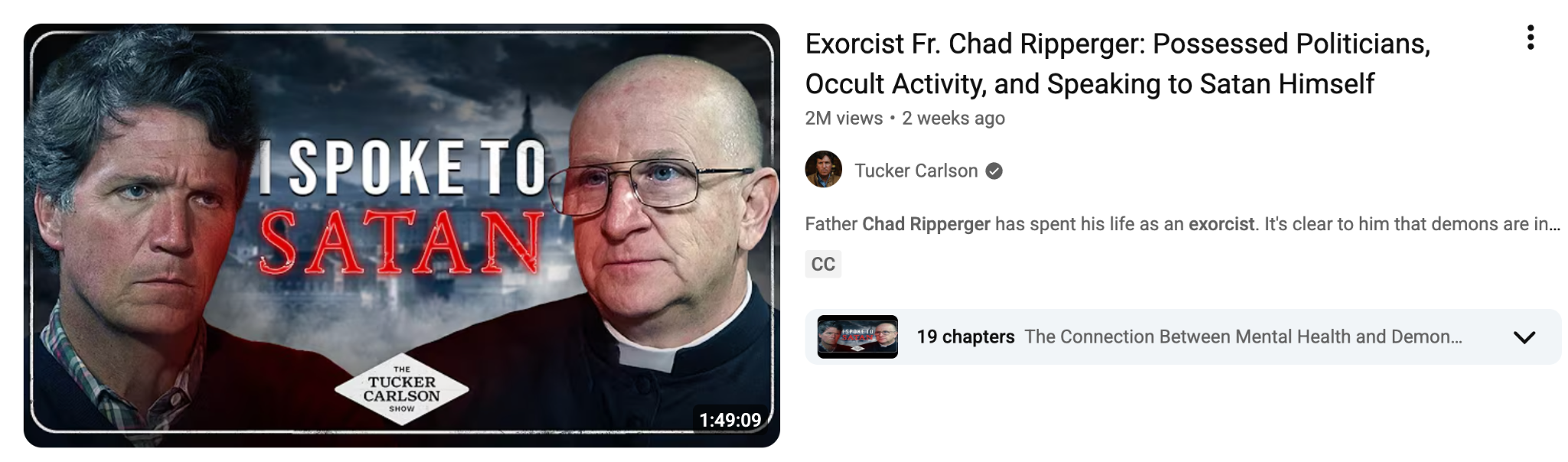
That this stuff now rockets around the internet virtually unchallenged is not just crazy-making in its own right, I’d argue — it’s very damaging to society. Much of it you might call Tuckerology, since he’s definitely one of the foremost proselytizers, having apparently convinced himself that he’s undergone some major religious epiphany since departing Fox News. Recently, he avowed that the United States is under “greater demonic attack” than ever before in our history. And he’s not being metaphorical about it. Especially disturbing was his latest foray into revival of “Satanic Ritual Abuse” claims — it was only a matter of time — which he conveyed to his mass audience with deadly seriousness, alongside a Catholic priest purporting to specialize in exorcism procedures. So we can almost certainly expect a marked uptick in podcast listeners reporting new cases of demonically-induced child sex crime, whether by “recovering” their own long-lost memories of such, or claiming to observe it contemporaneously among children exhibiting various behavioral problems.
According to the priest, the prevalence of Satanic child sex abuse surged in the 1980s, but then inexplicably “plateaued” for awhile, and is now back with a vengeance. Neither he nor Tucker appear to wonder what the explanation for this strange cyclicality might be: did Satan and his subordinate demons (such as Baal, the demon of fornication, and Loki, the demon of mischief) randomly decide to take a break in the 1990s, maybe because the economy was booming and the Soviet Union just collapsed? Or perhaps it has something to do with recurring cycles of media-fomented hype around scary demonological dangers? Because there definitely was such a cycle in the 1980s, and another one is now ramping up in the 2020s. But maybe that’s just a big coincidence. Maybe that’s what Satan wants us to think.
When this bunk gets commercialized and shoveled out for mass consumption — no doubt, there’s a huge market for such garbage — it gets packaged with a kind of baked-in conceit that to challenge any of these beliefs, no matter how loopy and brain-melted, would be an affront to Christianity itself. And would therefore be deeply wrong, because we dare not offend the sincere Christian believers by denigrating a long-established tenet of their “faith.” Christians believe in demons, and have since antiquity, we’re told — so just DEAL WITH IT. Rebuking this resurgent demonological worldview would be tantamount to rebuking Christianity itself, or at least Catholicism, depending on how you care to taxonomize the demon-belief chart.
OK… fine. I suppose we have to rebuke Christianity itself then. Not because every Christian must subscribe to the wackiest podcast spin that Tucker puts on his own demon blather, but because with or without Tucker, there has never been any good reason to believe that demons are roaming the land, infiltrating corporeal vessels at Satan’s direction. (If you believe in a conception of “demons” that is more metaphorical in nature, you are of less immediate concern, but the latest surge in demonological frenzy does not seem remotely confined to figurative expressions of “evil” or whatever.)
A reasonable person might ask: Huh? What does any this have to do with “religion” per se? Aren’t you just complaining about Tucker again? Didn’t you just get done telling us that “New Atheists” always said the real problem was religion itself — not just the most whacked-out manifestations of religious belief? And if we’re not “bringing back” New Atheism, surely we’re also not “bringing back” their blanket excoriations of all religion! Right?!?! Aaaahhhh!!!
Well, for one thing, this explosion of peasant-like superstition goes far beyond the digital walls of the Tucker Carlson Network, even though there are legions of impressionable “influencers” and politicians eagerly taking cues from Tucker’s own supernatural “journey,” and then subsuming its features into their own “content.” Case in point: JD Vance proclaiming his newfound belief that UFOs are actually “celestial beings” ordered by Satan to “fly around doing weird things to people.” This stuff is propagating to the public at a preposterous scale, thanks to the one supernatural entity we’re all forced to worship: the Almighty Algorithm.
But sure, there’s nothing new about an outsized demand for divinely-inspired nutbaggery among the denizens of the internet, and among humans in general. Crank eschatological prophecies, medical quack cures, ascription of misfortunes to Satanic interference, and so forth — this has all been around for ages. What’s new is that the “podcast sphere” — also known as Podcastistan, home of the Podcast Creatures — has become so unavoidably dominant in terms of audience reach and political leverage. And in this ascendant loon-infested sphere, any barrier that may have previously existed between the fixations of the freakoid fringes and the biggest bullhorns in the entire media ecosystem has been thoroughly evaporated.
So now we have this giant engine of madcap religious fervor bellowing at us 24/7, inculcating all kinds of warped pathologies, which are quite ominous, at least if you’d prefer for society’s mechanisms of knowledge-production to be somewhat anchored in reason. The feeble-minded magical thinking, bestowal of political and professional rewards for indulging in the craziest shit, the ballooning susceptibility to mass hysteria and moral panic, etc. — these are the fruits of the current infotainment environment. Not to mention genuinely grave matters of public concern being reduced to the equivalent of voodoo, as demonstrated by Tucker blaming the Iran War on a spooky “spell” that has tragically overtaken Donald Trump, whom Tucker claims to have recently discovered has no control over the Executive Branch.
Mind you, when Tucker starts declaring that Trump is “enslaved” by Israel, he isn’t making an evidence-based argument about Israel wielding too much power in the American political system. He’s positing that a supernatural curse has befallen the Commander-in-Chief, and if salvation doesn’t arrive soon, we’ll all be hurtling headfirst into the apocalypse. For example, after Trump issued his especially unhinged Easter threat to annihilate all of Iranian civilization, Tucker’s immediate response was to unsubtly theorize that Trump might actually be the Anti-Christ — without asserting this directly, of course. But everyone who was clued-in got the message: Trump is being manipulated by Satan (via Israel) as part of some grand cosmic plot to exterminate Christianity. That this could be interpreted by huge swaths of the citizenry as a non-insane diagnosis of US foreign policy just speaks to how outlandishly contaminated everything has gotten — which, yes, does strongly suggest some need for a full-throated corrective. Maybe not by importing obsolete “New Atheism” from the 2000s, but something. Something that could muscularly combat this campaign to disastrously impair the critical faculties of millions. No one in their right mind should welcome the mass-adoption of hallucinatory short-cuts for reasoning about consequential public affairs. There’s nothing positive to be gained by telling the average YouTube viewer that defaulting to vaguely mystical “conspiracism” is a solid means by which to process information, even if it’s being advertised under the banner of Christianity, or “religion” in general — which of course we’re supposed to solemnly respect, and withhold any rudeness toward, as a matter of common decency. But wait: what if it’s true that the origins of such fallacious thinking can be traced back to religious belief itself? And not just Tucker’s latest haywire capitulation of it?
Here’s where I have no choice but to get a bit edgy. I’m certainly not calling for anyone to go around evangelizing “atheism” per se. But I do think that a rational corrective to this insanity would have to include some resolute defense of the atheistic instinct — or at least of irreligiosity in some form or fashion. A few qualifiers: No, I don’t plan on obnoxiously confronting or “debating” anyone about their private religious views, just for the hell of it, and especially not ordinary people just going about their lives. (When it comes to woefully influential Podcast Creatures, the calculus necessarily changes.) I’m not going to lecture you, or anyone, to suddenly renounce your long-held religious convictions, merely because doing so would give me some sniveling self-satisfaction, because I’m so pompously sure that your religious convictions are dumb. I won’t be barreling into the Ozarks to upbraid local townsfolk who believe in demons. I won’t even tell the Podcast Creatures that they’re stupid if they don’t abandon the religious doctrines they’ve probably accepted to one degree or another since childhood.
But I’m also not going to arbitrarily credit this stuff as a rational heuristic for evaluating worldly affairs, or ascertaining moral wisdom, or deciphering political developments, just because certain people might take offense. “Facts don’t care about your feelings,” or to be more precise, a thoroughgoing defense of empiricism and reasoned, evidence-based inquiry — abundantly supported by a centuries-old corpus of philosophical and scientific pursuit — does not arbitrarily get negated because you like to chant “Christ is King” on the internet, or because you have fond memories of attending Church on Sundays with your grandma. Or even because you presently attend Church (or a Mosque or a Synagogue or whatever). The sincerity of your beliefs does not obviate the need to explain why totalizing monotheistic belief systems contain a direct route to the risible windbaggery now dominating the podcast circuit.
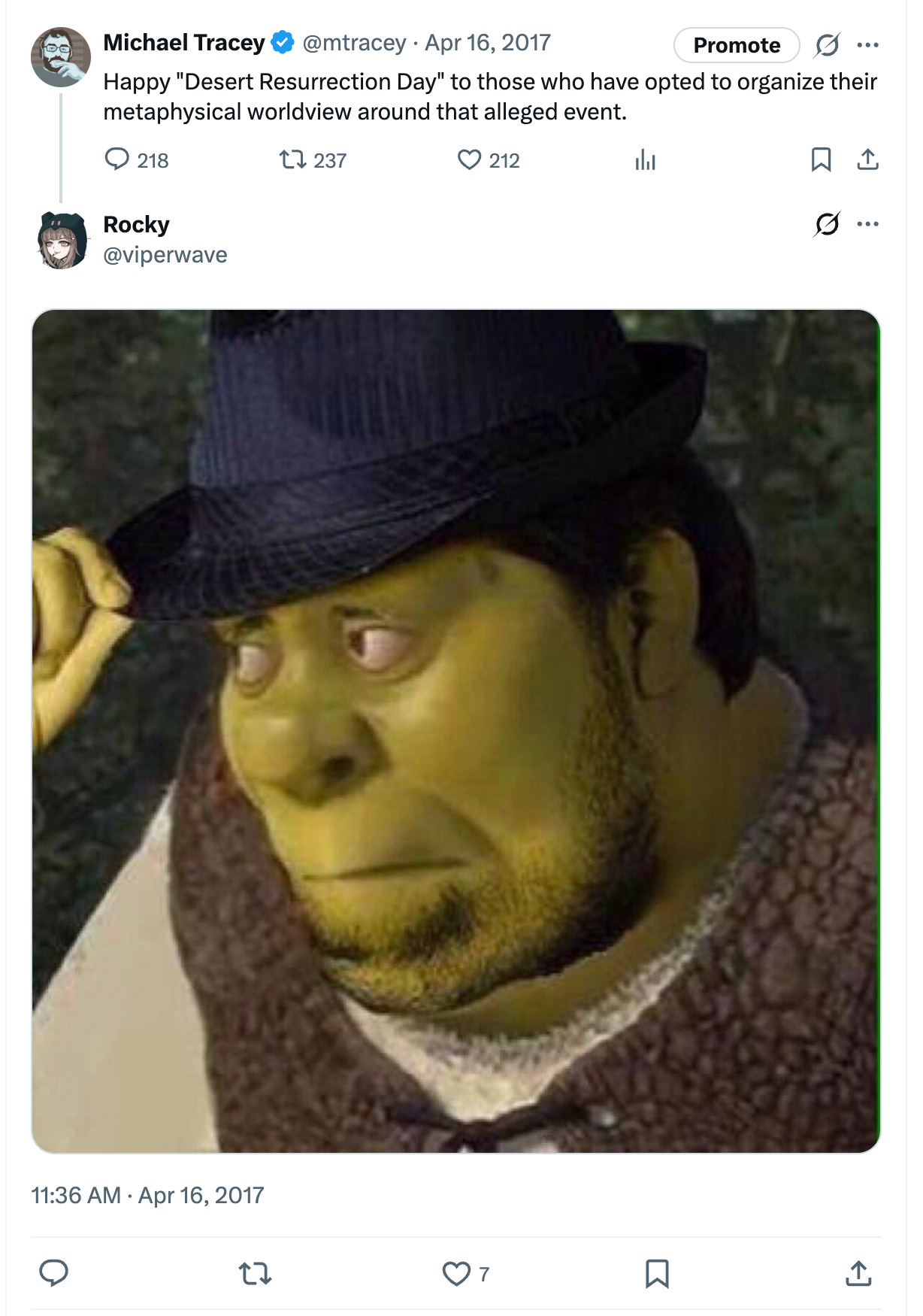
It’s also not a sufficient rebuttal to barrage me with the “Shrek wearing a fedora” meme, which for years I’ve had hurled my way whenever (on rare occasion!) I happen to evince some sign that I do not affirm, or accept the substantive validity of, whatever monotheistic dogma you’ve endorsed, based on ancient texts purporting to describe supernatural phenomena that took place in the Middle East thousands of years ago. Yeah, I know it’s trendy to deride as “cringe” anyone skeptical of grandiose supernatural claims. And that it’s really “based” to submit to the rule of some claimed supernatural authority. Failure to do so will result in you being instantly typecast as a smug, Cheeto-eating Reddit user.
I admit the following throwaway tweet of mine from nine years ago was kind of frivolous, and even needlessly provocative. Still, the basic point stands:
This article got much longer than I expected when I first started writing it, so I chopped off the (forthcoming) second half. Please do not take this initial entry as any kind of fully comprehensive treatise, intended to address every conceivable counter-argument. I haven’t even really made the argument yet! (And maybe never will!) I wrote this partially as a self-serving exercise in “thinking aloud” — gathering my thoughts about something that’s been irking me, but which I couldn’t quite articulate in any succinct way. “Part Two,” to be published soon, will delve into my own personal trajectory of religiosity and irreligiosity. I will propose that an “irreligious” disposition — baseline skepticism toward any kind of totalizing supernatural worldview — is especially helpful (even imperative?) when it comes to the practice of journalism. I will also distinguish “traditional” forms of religiosity from the more “secular” forms that also arise all-too-frequently in the modern era. (I’m against the latter, too.) The increasing secularization of the populace should by no means be taken to imply any sort of renaissance in rational thought. For the purposes of keeping this endeavor somewhat contained, I’m not going to branch out into any significant discussion of “Eastern” religions; I will stick with “monotheism,” which I define for practical purposes as encompassing Christianity, Islam, and Judaism. And yes, I’m aware that each of these three contains infinite multitudes and irresolvable internal debates. Again, this isn’t intended as an all-inclusive treatment of what is quite possibly the “biggest” subject that humanity has ever grappled with. It’s about locating an unwelcome trend in “public discourse,” and pondering what might be most profitably done as a corrective. The next “part” of this ad hoc series will be paywalled, so please consider subscribing if you’ve found this at all interesting. (If you haven’t found it interesting, I bear no grudge.) And yes, I of course came up with a way to shoehorn in Epstein.
As a fellow atheist and also someone who has studied child sexuality abuse hysteria, I believe that superstitious religiosity is only half the story. The other half is patriarchy-obsessed feminism, associated with demonizing men. Of course, men do the vast majority of bad sexual things, from coercion to child molestation to sex murder. But most men are innocent and well meaning. For a revealing account of the role of feminism in the 1980-1990s CSA hysteria manifested in (false) belief in recovered memories, which affected millions of families read Meredith Marian’s book “My Lie” or this: https://www.psychologytoday.com/us/articles/201009/two-minute-memoir-my-lie
It used to be cool to be the anti-establishment fact-checker, rationalist, skeptic, etc. in the late 2000s, early 2010s. Today if you do that somehow you're considered narrow-minded and missing the wider, cosmic significance of otherwise earthly, relatively mundane transgressions. It makes me think we're regressing...young people aren't reading books as much as earlier gens, there are fewer stable relationships, more anxiety about the future. They cling to podcasts and online communities as a coping mechanism.