

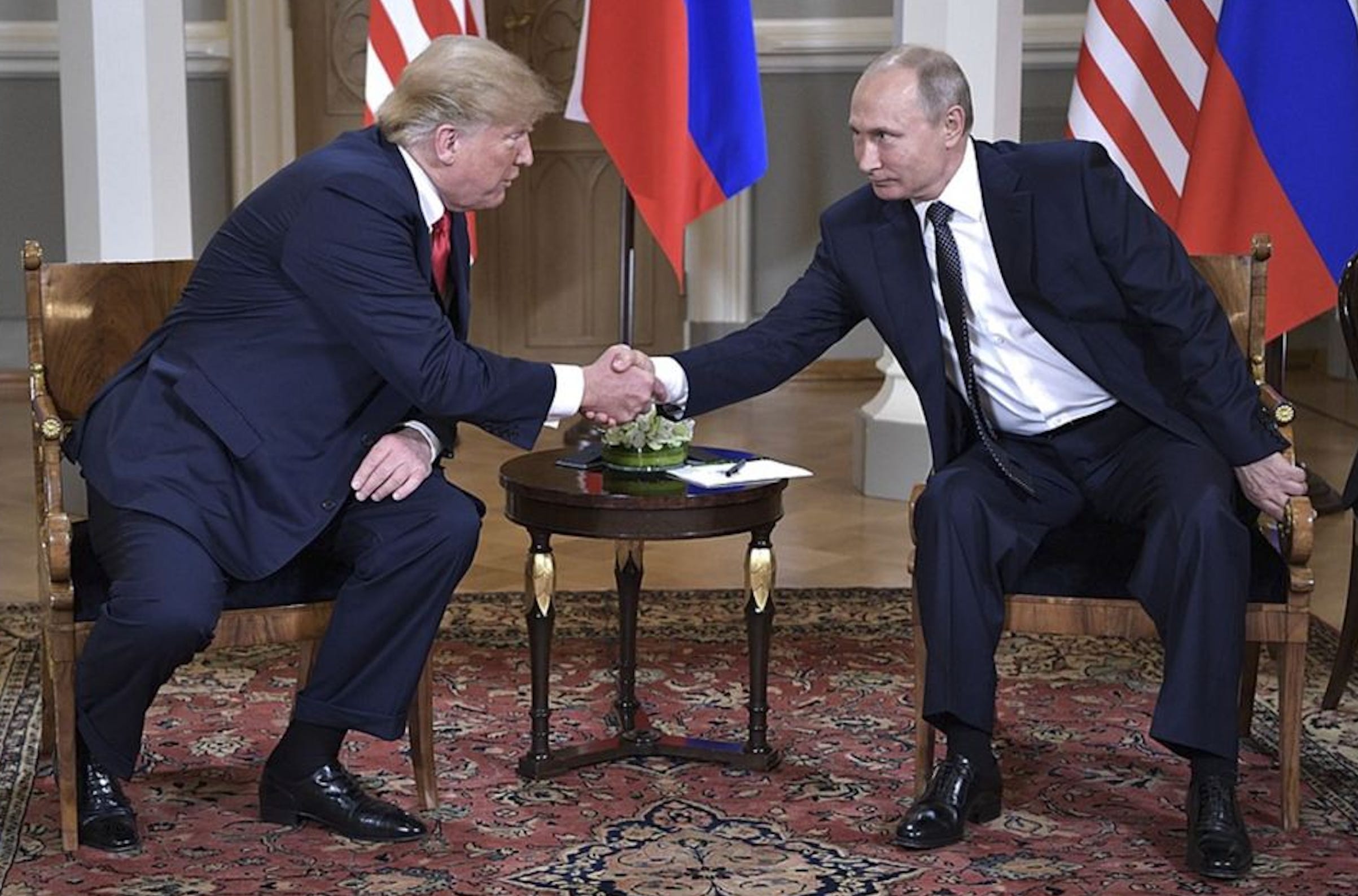
Not to belabor the point, but on the matter of potential Russiagate prosecutions, here’s something I should’ve mentioned in my unplanned debate yesterday with Matt Taibbi: my general position is that “Russiagate,” broadly construed, is best understood circa 2026 as an unresolved political problem — and one that can now be said to have occurred in the somewhat distant historical past (OK, the relatively recent past). Any measures that might be warranted to remediate this decade-old political problem, therefore, would be most aptly pursued in the political domain, rather than by application of punitive criminal law.
One of the core problems I always had with “Russiagate,” an admittedly nebulous term, was that issues of ordinary political disputation — such as whether Trump appeared to be favoring foreign policy prerogatives that were overly aligned with Russia — got wildly warped into some kind of urgent “national security” crisis, and in tandem with that overwrought theme, the federal law enforcement apparatus deemed itself authorized to barrel head-first into the political arena with unprecedented audacity. The entire premise of this “Deep State” intervention was fallacious and destructive, I’ve always argued, and the successive Russiagate ops by the Feds, starting with “Crossfire Hurricane” in July 2016, followed by the Robert Mueller (RIP) Special Counsel saga in May 2017, were themselves fundamentally predicated on a slew of destructive fallacies.
It was obvious that what ultimately gave rise to these brazen law enforcement gambits was the wider political outburst that’d been triggered by Trump’s overall ascendance, and among the most self-righteous purveyors of this spasmodic outburst were factions of the FBI, who connived to reify their political anxieties through “novel” application of punitive state power. In other words, they arrogated authority to referee a roiling political dispute, although they’d never admit it — and made the tactics they employed appear all the more existentially vital, thanks to the conjoined theatrics of the “Intelligence Community,” or at least certain elements therein. The whole Russiagate episode did tremendous damage, for a host of reasons, which I chronicled almost daily from around 2016 to 2019. (Here’s one small example, among countless I could dig up.)
Cheering these encroachments by the National Security State into domestic political affairs — the consensus reaction among left-liberals at the time — struck me as uniquely repellent, whatever the hell one ever thought about Trump. That’s why I made it such a huge journalistic focus of mine. But as to what remedies might be practicable today, in 2026…?
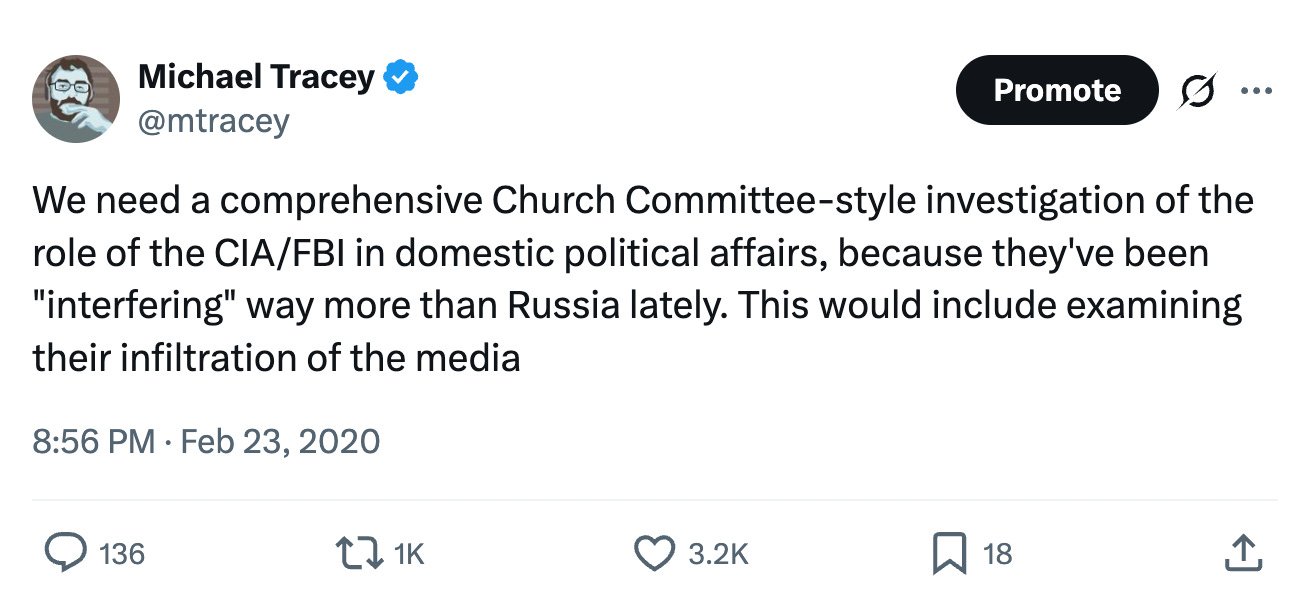
Well, I’m not usually in the habit of proposing “solutions,” because sometimes there just aren’t any, but even so, I’d have thought a no-brainer would’ve been to establish some kind of big-league Congressional inquiry, modeled on the landmark Church Committee of the mid-1970s — which despite its imperfections, did unearth a great deal of hitherto hidden information about the dark inner-workings of the Security State complex, which till then had been cloaked in almost impenetrable secrecy since it was regrettably created after WWII.
***As a brief aside, one glaring flaw of the Church Committee was that it did not adequately probe the out-of-control antics of John F. Kennedy and his bagman brother Robert F. Kennedy — described, inter alia, by Seymour Hersh in the tragically underrated Dark Side of Camelot (1997). Hersh writes that evidence linking JFK and RFK to ZR/RIFLE, a clandestine CIA caper to assassinate foreign leaders, most obsessively Fidel Castro, was “overwhelming” — and much of this evidence was known to Church’s Committee as it scoured through various chapters of CIA chicanery. But “for political reasons,” Hersh says, the matter was not robustly pursued, as Democratic Senator Frank Church did not want to disrupt his party’s cherished Kennedy lore. This is just one datapoint, of many, that made such a complete farce the latter-day exaltation of RFK Jr. as some kind of valorous warrior against the “Deep State,” even if the dumb-dumb podcaster guys all giddily ate up that weird inverted “Camelot” narrative he concocted, and then proceeded to subsume into the GOP, having cleverly imbued himself with an aura of nonsense bizarro nostalgia around his BS family lineage — as though RFK Jr. was on an epic hero’s journey to finish the Deep State-slaying mission of his martyred dad and uncle. My IQ dropped a few points just summarizing it.
Anyway, something akin to a Church Committee for the 2020s, excavating whatever’s yet to be excavated about the recent conduct of the National Security apparatus, always seemed a perfectly creditable political remedy to the problem of “Russiagate,” such as that problem continues to exist. Informative public hearings could conceivably be held, appropriate fact-finding undertaken, and remedial legislation then to emerge, perhaps with an eye toward curbing excessive government surveillance powers, or at least restraining the Security State from intruding in presidential campaigns. Which undoubtedly did happen with Trump in 2016, on totally scurrilous grounds. During the Biden Administration, it even became an occasional MAGA talking point, promoted by the likes of Matt Gaetz and such, that the time had surely come for Church Committee 2.0, and Republicans would have this at the top of their agenda if they retook Congress in 2022 and/or the Presidency in 2024.
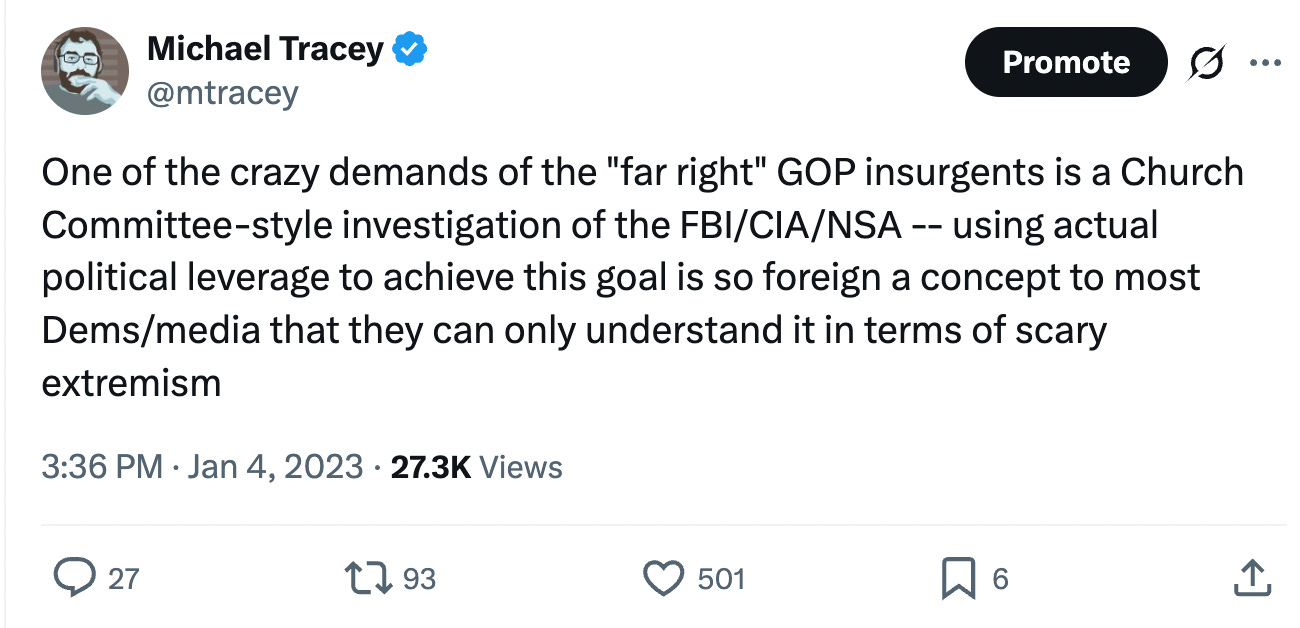
Well, we haven’t heard much about that idea lately.
And why do you figure that might be?
Hmm. Let’s ponder.
Maybe because Donald Trump has no interest in actually curbing the powers of the “Deep State.” His singular grievance has only ever been that those powers were once marshaled to his own detriment, and yes, he was often substantively correct in his complaints. But now, in Term Two, he’s got thoroughly consolidated control of the Executive Branch. No longer are there any bureaucratic holdovers maneuvering against him, as in the First Term, hiding away in their little ideological silos to plot and connive. Indeed, Trump has now comprehensively imposed his own ideology on the Security State structures, and we all know the main feature of Trump’s ideology is personal allegiance to him. That being the case, he’s all in favor of exerting audacious state power, so long as it serves his own interests — rather than getting him caught up in another open-ended Special Counsel fiasco, as bedeviled him the last time both politically and practically, having constricted his latitude to govern. No such nuisance bedevils him in 2026. Russiagate? Schmussagate.
Look no further than his current unbridled enthusiasm for renewing FISA, the very warrantless surveillance law once notoriously used against him in 2016! Pay no mind — that’s all ancient history in Trump 2.0. (He actually supported FISA renewal in his first term too, when the contradictions were even more pronounced.) And while he continues to superficially grouse about FISA here and there, the kicker came during the 2024 campaign season, when he and “MAGA Mike” Johnson huddled at Mar-a-Lago and jointly endorsed that year’s FISA renewal package, because, as Trump would explain, he was ahead in the polls! And accordingly, he would soon be the one exercising the relevant powers again, and doing with them as he pleased — so why get rid of them now? That’d just be shooting himself in the foot. President Donald J. Trump is many things, but he’s never been somebody who seems particularly inclined to diminish his own power.
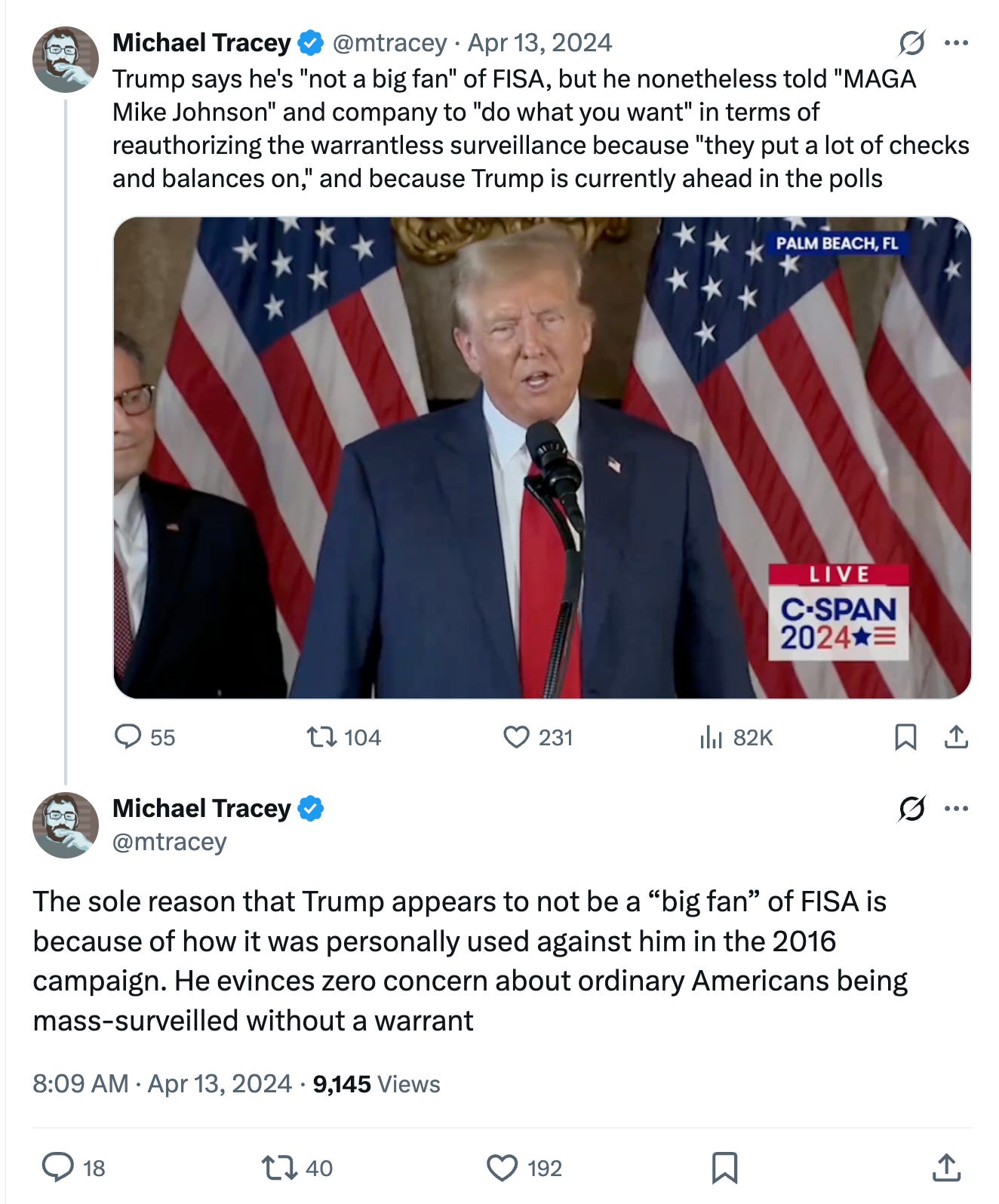
So there you have it — the key legal architecture underpinning Russiagate is still in effect, today and for the foreseeable future, thanks to the boisterous personal advocacy of Trump, who now claims it’s “desperately needed” for his “little excursion” in Iran:
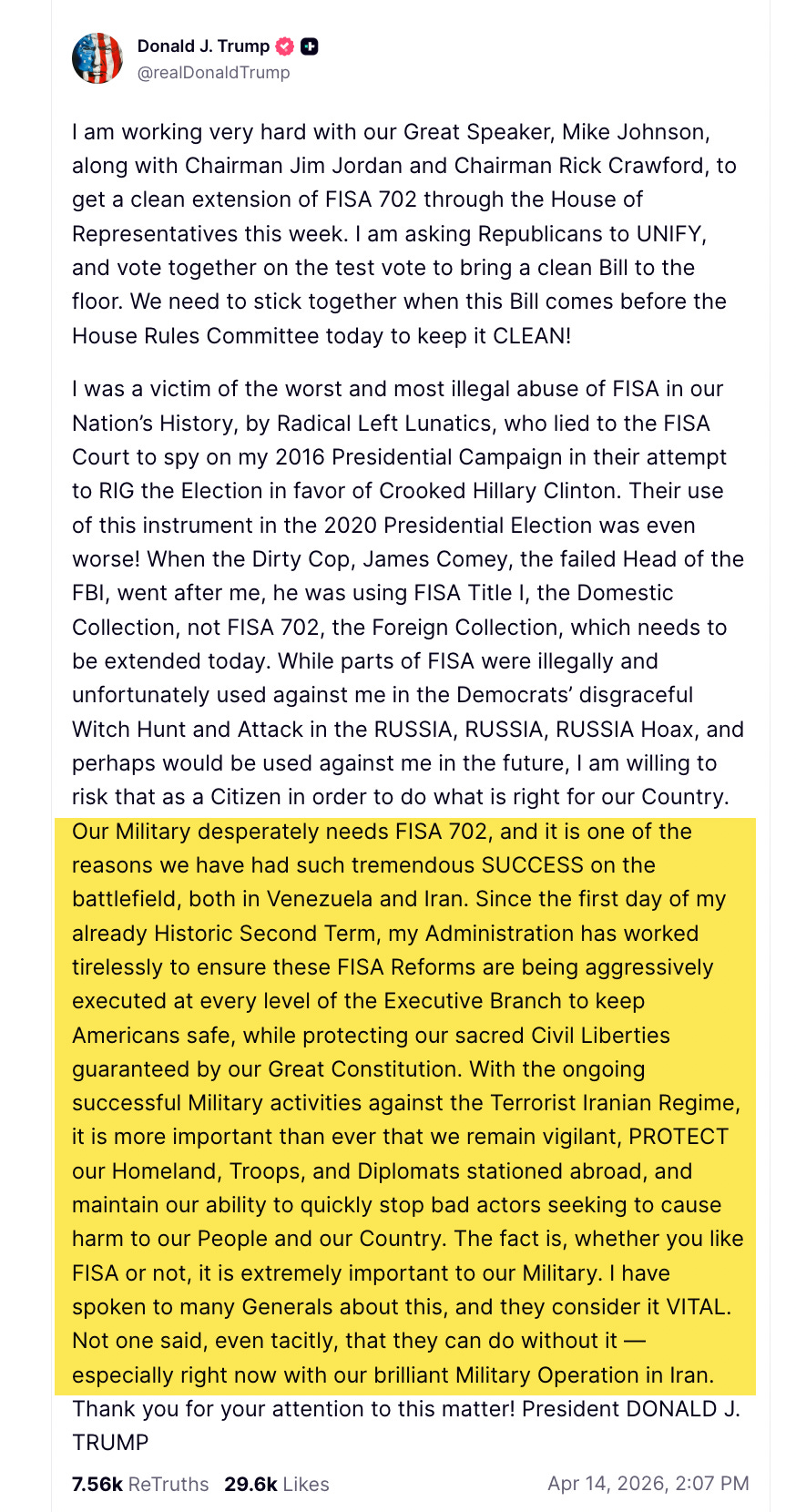
Trump does passingly remind us that the FISA “instrument” was once used against him by one of his arch nemeses — “the Dirty Cop, James Comey” — but don’t fret, MAGA faithful: extremely reassuring reforms have been taken, namely that Trump himself is back in charge, and he’s organized the Executive Branch more to his liking. Meanwhile his Clown Show underlings at the DOJ roll out another ridiculous case against Dirty Cop Jim, after botching their first attempt — but now they’ve regrouped, and are nailing him for the heinous crime of posting a photo of some seashells on Instagram. Which we’re supposed to believe constituted Comey threatening to assassinate the President. Weird that if the seashells were so menacing, it took almost a year to indict Comey for photographing them, since this could have easily been done within about 24 hours of the initial May 15, 2025 post. It’s not like months and months of profound legal contemplation was required here. The indictment is a comically barebones two pages, literally charging Comey for posting an Instagram photo from his little beachside stroll. Weird, also, that it comes after they already screwed up their prior indictment of Comey, after Trump installed a 30-something bimbo as interim US Attorney in Virginia, with zero prosecutorial experience, which predictably resulted in the charges getting tossed.
They’re deliberately insulting our intelligence with this stuff. Sure, it’s true, as I documented at the time, that “the process is the punishment” — that was definitely the case with the Mueller Investigation, which embroiled all manner of tangential Trump-connected stragglers in a fishing expedition that never found the phantom “collusion” it was nominally set up to find. And even though forgotten bit-players like Jerome Corsi and Michael Caputo were never charged with anything, their lives were still upended for roughly two years, not least with exorbitant legal fees, but also just the threat of federal prison hanging over their heads, which takes a huge psychological toll. Is that what Trump’s trying to replicate with Comey? Probably so. The obviously meritless nature of these indictments would thus be entirely explicable, because however devoid of merit an indictment might be, having to deal with the federal government bringing any indictment against you is more than onerous “punishment” unto itself.
Let’s not get silly, though. “Going after” Comey this way, based on political grievances originally stemming from Russiagate, does nothing to substantively rectify the wrongful government conduct associated with Russiagate. There is no “accountability” to be gained with this routine — or at least none that would meaningfully curtail the excesses of the National Security State, which Trump is now eagerly deploying for his own ends. Be real: Trump manifestly does not want any serious interrogation of “Deep State” activity, because that would require interrogating the very activities of which he’s now in control — and is keener than ever to aggressively wield, both home and abroad. Is it possible that DOJ ends up indicting some additional Russiagate villains, like John Brennan, the crazed former CIA Director and current “pro-democracy” pundit? Sure, it’s possible, maybe even probable. Is it possible that certain material might be uncovered over the course of that theoretical prosecution, which could fill in certain aspects of the historical record re: Russiagate? Sure, that’s also possible. But it’s also extremely likely that the whole thing just devolves into yet another shambolic mess, yielding nothing of real value, other than to satisfy Trump’s personal pique, just like the rest of the “retributive” score-settling so far. (Comey Part One? Bust. Letitia James? Bust. Jerome Powell? Bust. Mark Kelly? Bust.)
So no, I’m not seeing any legitimate civic-minded quest for True Russiagate Accountability, defined as something that would actually advance the public interest, or improve public policy, or accomplish much of anything else worthwhile. What I’m seeing instead are the predictable results of a myopically one-man-show administration, where everything invariably revolves around him, and whatever addled predilections he’s got bouncing around in his head on any given day. TO BE FAIR: This is exactly what he promised the electorate! “I am your retribution” was a pretty creepy proclamation, because it invites the average citizen to view him as their spiritual avatar, like a National Father Figure or something, rather than as a political vehicle through which to attain things that would benefit the entire polity. But it’s still what he openly vowed to voters: satiating his personal lust for “retribution,” sold as vicarious liberation for Joe and Jane Sixpack. And he won the 2024 election on that very explicit, repeatedly-articulated vow. So… ho-hum. Yeah, I get how the mythical logic can resonate for his hardest-core supporters, who really do think him getting payback against a rotating cast of antagonists will lower their gas prices or whatever, but it’s also a substantively idiotic proposition, and could only have been salable with the aid of a monumental Personality Cult.
For this and other reasons, expecting some Revelatory Russiagate Reckoning through the ad hoc deployment of vindictive law enforcement power — it’s just pure folly. It solves none of the underlying political problems that caused Russiagate in the first place, such as the semi-autonomous ability of Security State agents to meddle in domestic political events. It does drastically accelerate the trend of American political conflict giving way to tit-for-tat prosecutorial warfare, whereby the conflicts are adjudicated not by standard political means, but through the criminal justice system — an absolutely horrible venue for adjudicating political conflict. And yes, I say this as someone who was loudly critical of all four Trump prosecutions when he was out of office. Go check the record if you want. So I’m well aware that this trend I’m bemoaning was likewise accelerated by retributive Democrat zeal against Trump. But that doesn’t mean I’m suddenly going to start celebrating another great leap into Mutually Assured Destruction, just because it’s Trump’s turn again to punish his rivals. The whole dynamic is woeful. It corrodes the larger political culture in a very foundational way, and sends us hurtling into Banana Republic territory even faster than we already were. The unhinged reaction to Trump by blithering liberals and their Security State companions was a sure sign of Banana Republic degeneration over a decade ago. Trump pouring another gigantic can of fuel on the fire is not something to be welcomed for its own sake, or because it activates some nerve in your cranium that chemically induces you to crave carceral punishment for people you dislike. (Although if you’re just a pure partisan simpleton, I can see why your lizard-brain would be lighting up at the thought.)
As with so much that has transpired in Trump 2.0, this was all bleakly foreseeable, at least if you weren’t hoodwinked by algorithmic hackery, or otherwise occluded from apprehending obvious political reality. Remember that “Project 2025” document emotionally-disturbed liberals were constantly screeching for us all to be so gravely fearful of? Here’s what I wrote about it in July 2024:
When it comes to what’s commonly referred to as the “Deep State” in MAGA parlance — aka, the “Intelligence Community” — Project 2025 contains virtually the opposite of what’s being suggested by hysterical libs. (Go figure). Fundamentally, the guidance calls for marginally re-organizing the Intelligence Services so as to empower them.
Trump loves to grouse that elements of the National Security State were irrationally against him in 2016-2018, and that’s true as far as it goes, with the Russiagate/Mueller fiasco being proof of these tawdry machinations. So it would make sense that Trump and the people in his orbit would want to impose various safeguards to prevent any future sabotage against Trump. But the idea that this means Trump would radically overhaul the “Intelligence Community” and put it in service of Putin and Kim Jong Un, or whatever other nonsense, is just entirely wrong. Simply read the text!
[…]
With regard to the CIA, Project 2025 decries the tendency of “risk aversion or political bureaucracy to delay execution of the President’s foreign policy goals.” It thus recommends the diminution of bureaucracy and placement of individuals in the agency who will more effectively harness the power of clandestine operations to fortify and expand American hegemony. Another huge shocker!
The “intelligence” section of the document further advises the renewal of FISA warrantless surveillance, declaring that “Section 702 should be understood as an essential tool in the fight against terrorism, malicious cyber actors, and Chinese espionage.” Which again nicely aligns with Trump’s position, so far as it can be ascertained, seeing as he backed MAGA Mike Johnson’s successful effort to renew FISA in April, on the understanding that they both wanted Trump to be the one wielding that power when it next comes up for reauthorization in two years.
Sorry to toot my own horn here, but this is pretty much exactly what’s come to pass. You want a big cathartic Russiagate Reckoning? Fat chance. What you’re currently getting, good and hard, is just a further empowerment of the Security State Goliath — the fruits of which brought you Russiagate in the first place. Except now it’s being commandeered by the ideological manias of Trump 2.0, or “Trump unleashed” as I sometimes call it. Which could easily just bring us a thousand more Russiagate sequels.
JFC dude... PUT THE THESAURUS DOWN!
You just spent hours looking up words that serve no purpose other than to DESCRIBE YOU OWN POMPOUS IGNORANCE of the facts in the "Russiagate" matter.
"Russiagate" isn't and never was the major problem.
"SPYGATE" which preceded "Russiagate" and directly TRIGGERED it in its entirety is THE PROBLEM!
So what is "Spygate."
"Spygate" is quite simply The Obama Administration WEAPONIZING the entire Executive Branch of The United States Federal Government to SPY ON and ATTACK their POLITICAL opposition.
It began with Lois Learner and The IRS scandal. Then after getting CAUGHT doing that, Team Obama went nuclear. They just started using the nation's most top secret spying powers and authorities against their opposition. Access to the Top Secret NSA Database was given to partisan DNC operatives(A terminal was installed in a Perkins Coie Office FFS), subsequently The FISA court, FISA warrants and National Security Letters were issued after NSA cut off contractor access to The NSA Database. You might remember Admiral Rodgers of The NSA SHUTTING THIS DOWN in early 2016.
Obama BROKE EVERY RULE IN THE CONSTITUTION! He did it knowingly and blatantly. WHICH IS WHY "RUSSIAGATE" happened. Barack Obama is a criminal. He HAD TO COVER UP HIS CRIMES!
So Obama took Hillary's risible "Russia Collusion Hoax" and injected it right into the mainstream of The CIA, The FBI, The DOJ and The DOJ National Security division. Which led directly to all of the events you mentioned in your article.
How YOU MISSED THE GENESIS of that stupid hoax is beyond me. Why on earth would Obama be so damn stupid as to let all of this mess happen?
Because he WAS GUILTY of MASSIVE CRIMES against The American People.
It's the only thing that makes any sense Michael. The arrogant bastard never thought his side would lose an election again. He made a fatal miscalculation.
He's about to go down in flames for it. THAT is the outcome Trump and his supporters are looking for Michael, it's not "retribution." It's known by it's actual name....JUSTICE!
Americans will settle for nothing less. Research more, look up fancy words less, you won't look so ignorant of the actual facts in the future.
Yes, Michael. Unlike the unseemly riot of J6, Russigate was an actual coup d'é·tat. Insular and cryptically guarded, but a legit attempt to undermine and eventually overthrow a duly elected President. I enjoyed the debate between you and Matt, but I gotta go with Matt on this one.